Travel guide
Hanoi French Quarter architecture walk: streets, façades and city life
Hanoi’s French Quarter rewards a slower walk with your eyes on the buildings as well as the pavement. The national tourism authority describes the area south of the Old Quarter through broad streets, green spaces, villas and colonial-era architecture. The appeal is the contrast: instead of trying to collect every famous address, notice how street width, building frontage and planted spaces change the feel of the city. Keep the walk centred on architecture visible from public places.
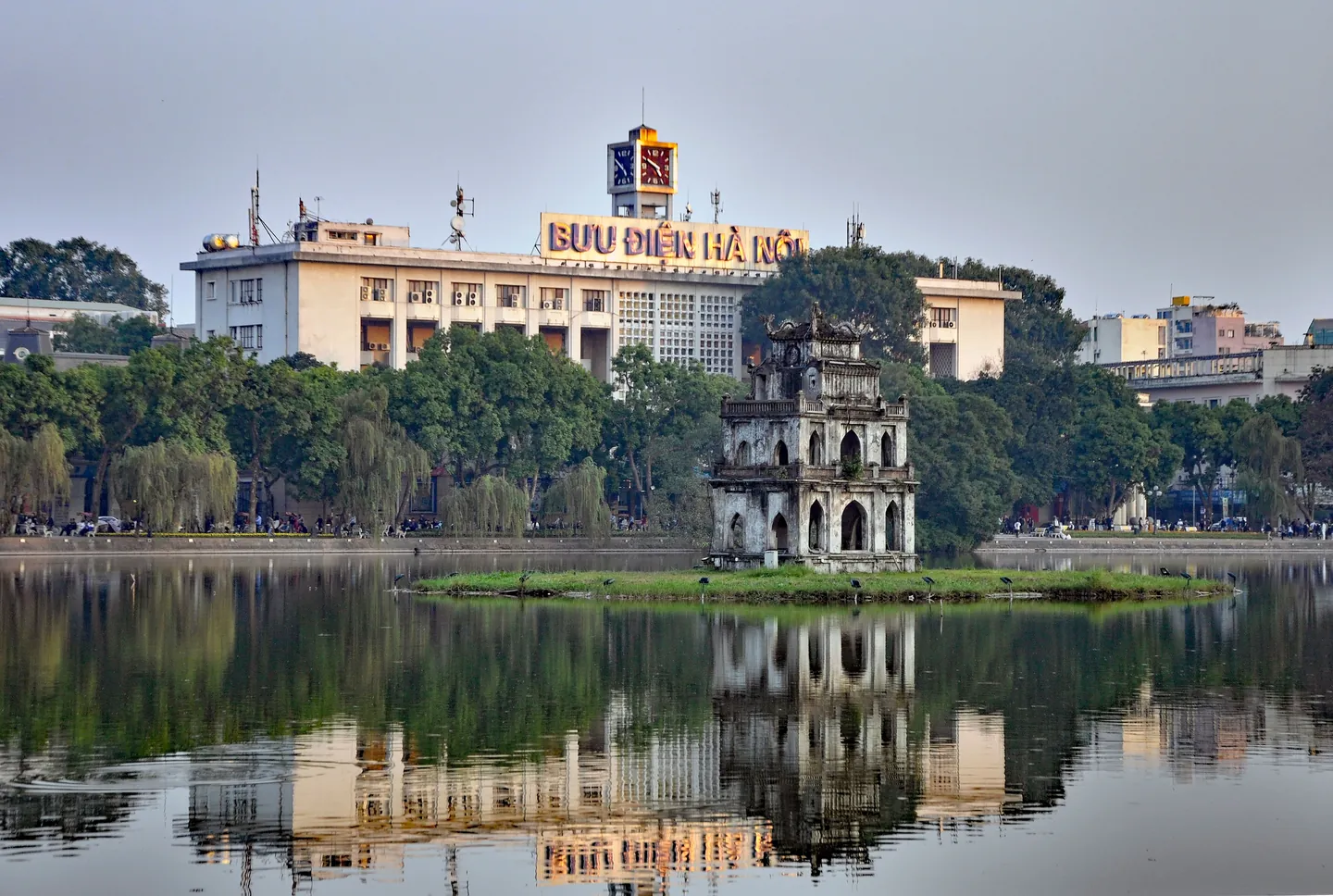
Illustrative photo: Turtle Tower on Hoan Kiem Lake with Hanoi Post Office behind it. ·

Read the contrast between streets and buildings
Use the Hanoi Opera House as a visual landmark, then compare the surrounding streetscape with the tighter urban fabric nearer the Old Quarter. Look at a façade as a composition: the rhythm of windows, the relationship between the entrance and the street, and the way trees interrupt or frame the view. These are observation prompts, not a claim that every building belongs to one architectural period. Hanoi’s streets contain changes and additions; a colonial-era label does not describe everything you see.
Choose a compact walk rather than every landmark
A manageable option is to combine the southern side of Hoan Kiem with the Opera House area, leaving time to pause and compare details. The tourism authority also connects the wider area with Ba Trieu, Nguyen Du and Thien Quang Lake. Treat those as optional extensions, not proof that all the sights are immediately adjacent. Choose between an architectural walk and a museum visit according to your interest, rather than compressing both into every stop. A café break can be a useful chance to look back at the streetscape.
View exteriors without assuming interior access
An attractive entrance is not automatically open to sightseeing. Check directly if you want an Opera House performance, an interior tour or entry to another institution; public visibility alone establishes none of those. Observe from permitted pedestrian space, keep entrances clear and cross roads carefully. There is no need to enter private grounds to enjoy the architecture. For any indoor stop, verify that building’s current arrangements before adding it to the route.
Ask VietnamGuide AI
Ask VietnamGuide AISources
- 1. vietnam.travel/node/643
Source checked:
- 2. vietnam.travel/things-to-do/11-must-see-attractions-ha-noi
Source checked:
Explore more
- Hanoi MICHELIN dining: understand the distinctions before choosing
Choose Hanoi dining by MICHELIN Star, Bib Gourmand or Selected status, cuisine and meal format; verify the exact restaurant before reserving.
- Hanoi cooking classes: choose a format, not just a menu
Compare a Hanoi market-and-cooking class with a private menu session; ask what you will prepare, how ingredients are handled and what is included.
- Hanoi on a rainy day: replace the exposed part, not the whole trip
Build a flexible Hanoi rain plan around one indoor visit, short transfers and optional lake walks, while checking each venue and the actual forecast.