Travel guide
An Quang Pagoda: Buddhist learning and a changing city
Ấn Quang Pagoda at 243 Sư Vạn Hạnh is a useful choice for travelers interested in Buddhist learning as well as religious architecture. Its story is not simply that of an old building preserved without change. The national tourism authority describes a twentieth-century institution that developed through teaching, new construction and rebuilding. Following those stages gives this particular pagoda an identity beyond a general list of Ho Chi Minh City temples.
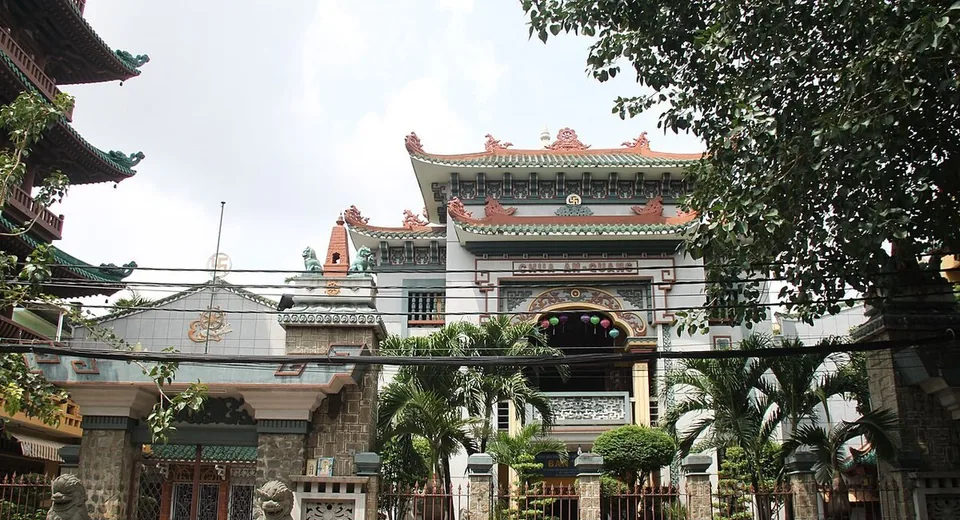
Facade and roofs of An Quang Pagoda, Ho Chi Minh City ·

From Ứng Quang to a place of Buddhist education
The official account records that Thích Trí Hữu founded the pagoda in 1948 under the name Ứng Quang. In 1950, Thích Thiện Hòa developed the main hall and Buddhist school. The later name Ấn Quang is associated in that history with Phật học đường Nam Việt. When reading a historical reference, therefore, Ứng Quang and Ấn Quang should not automatically become two destinations on your map. The earlier name and the school connection explain successive parts of the same institution’s development.
Rebuilding is part of the heritage story
The tourism account describes reconstruction during 1955–1978 following a design by Nguyễn Hữu Thiện. This longer period is more informative than attaching the foundation year to everything visible today. It invites a distinction between the beginning of the religious institution and the physical form shaped later. Visitors can approach the main hall with an interest in that changing history, without assuming that every detail survives from 1948 or assigning unverified dates to individual features.
A learning history is not an invitation to enter classes
The educational connection explains why Ấn Quang matters; it does not establish that visitors may attend classes, enter residential quarters or use institutional spaces. Historical statements about offices in the source should likewise not be read as proof of present headquarters functions. Ask attendants which public religious areas may be visited, and give worship and community activities priority. No current opening hours, admission prices or teaching programme are established here. Use the verified street address for directions rather than treating former district labels as current administrative evidence. For a broader itinerary, the published city history walk supplies context while this stop keeps a distinct focus on Buddhist education and twentieth-century change.
Ask VietnamGuide AI
Ask VietnamGuide AISources
- 1. vietnamtourism.vn/index.php/tourism/items/265/2
Source checked:
Explore more
- Saigon railway station: match your train, ticket and identity
Plan a departure from Ga Sài Gòn by separating station identity, ticket details and dated railway identification guidance.
- Can Gio mangroves: understand the reserve before choosing a visit
Understand Can Gio’s UNESCO biosphere identity, connected coastal habitats and the difference between a reserve-wide landscape and a managed Vam Sat visit.
- Tran Hung Dao Temple: a memorial beyond the riverfront statue
Explore the Trần Hưng Đạo temple on Võ Thị Sáu through its memorial layout, bronze figure and interpretation of the historical commander.