Travel guide
Chantarangsay Pagoda: Khmer Buddhist heritage beside the canal
Chantarangsay Pagoda and Candaransi are names for the same Khmer Theravada Buddhist place in Ho Chi Minh City. Its setting beside the Nhiêu Lộc canal on Trường Sa gives travelers a different religious and streetscape context from a city-centre church or memorial. The strongest reason to choose this stop is its particular community tradition, not an assumption that all pagodas in the city represent the same form of Buddhism.
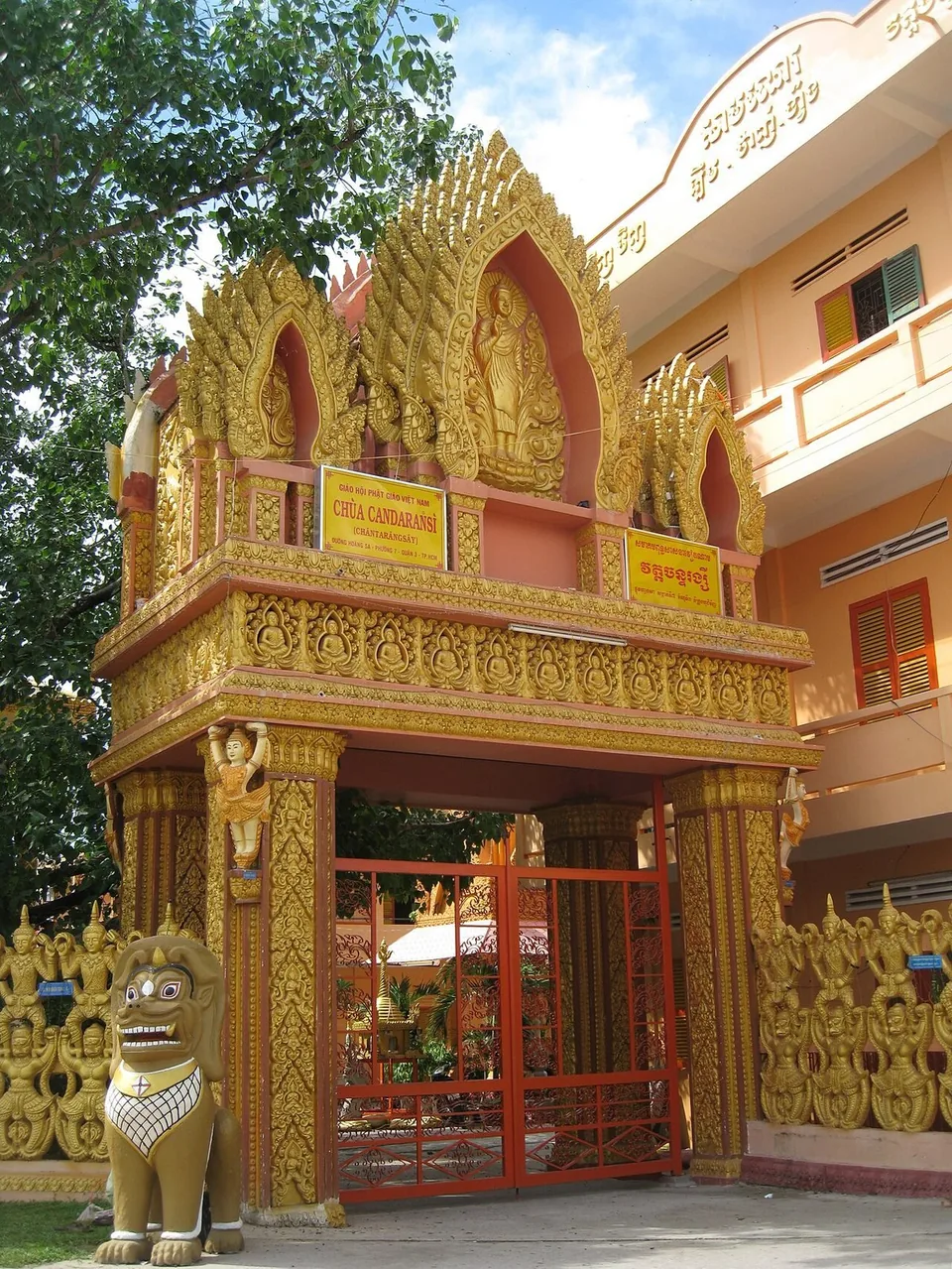
Gateway of Chantarangsay Pagoda, Ho Chi Minh City ·
Nguyễn Thanh Quang · CC BY-SA 3.0 · Resized and converted to WebP

A Khmer community setting established in 1946
Giác Ngộ, the newspaper of the city’s Buddhist Sangha, records that Lâm Em founded the pagoda in 1946. The account describes its place in Khmer Buddhist community life. That foundation date identifies the institution’s beginning; it should not be used to date every structure now on the grounds. When comparing names in a map or guide, keep Chantarangsay and Candaransi together so that one site does not become two entries in an itinerary. The verified source supports the Trường Sa canal-side setting, without requiring an invented street number or a current administrative label.
Read the architectural vocabulary as a connected whole
The Buddhist account describes three-spired forms and decorative imagery including Naga or Neak, Krut and the lotus. These named elements give a more specific observation framework than simply calling the building colorful. Its account also identifies the main hall, a sala and memorial or ash towers within the grounds. Read these as parts of a religious community’s setting, rather than assuming every building is a sightseeing room. Where interpretations concern faith or symbolism, understand them as religious and cultural explanations, not objectively proven supernatural claims.
Choose an attentive visit without promising interior access
The source is an April 2025 account with photographs and architectural context. It establishes the identity and described features, but not today’s opening hours, ceremony schedule or access to every space. Ask attendants which areas may be visited, especially when worship is taking place, and request permission before photographing people. An exterior or permitted-ground visit can still focus on the canal setting and Khmer design vocabulary without requiring entry everywhere. For a broader itinerary, connect this specific interest with the published city history walk, leaving room to compare religious traditions without treating one site as a substitute for all the others.
Ask VietnamGuide AI
Ask VietnamGuide AISources
Explore more
- Saigon railway station: match your train, ticket and identity
Plan a departure from Ga Sài Gòn by separating station identity, ticket details and dated railway identification guidance.
- Can Gio mangroves: understand the reserve before choosing a visit
Understand Can Gio’s UNESCO biosphere identity, connected coastal habitats and the difference between a reserve-wide landscape and a managed Vam Sat visit.
- Tran Hung Dao Temple: a memorial beyond the riverfront statue
Explore the Trần Hưng Đạo temple on Võ Thị Sáu through its memorial layout, bronze figure and interpretation of the historical commander.