Travel guide
Phụng Sơn Pagoda: religious art and archaeological layers
Phụng Sơn Pagoda, also known as Chùa Gò, offers two different ways to read one place: religious art and evidence of an earlier archaeological landscape. The recorded address is 1408 Ba Tháng Hai, Ho Chi Minh City. Knowing both names is useful when arranging a visit, but the archaeological association should not be confused with the age of the present Buddhist institution.
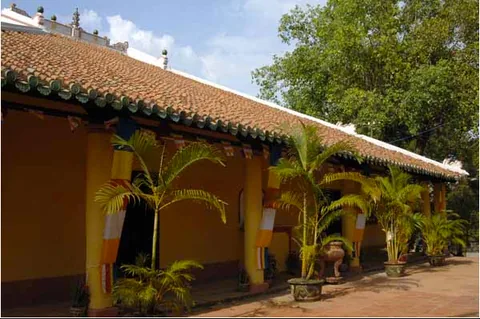
Tiled roof and yellow facade of Phung Son Pagoda in Ho Chi Minh City
Ân Phật · Resized and converted to WebP
Separate the temple’s history from its earlier setting
The national tourism authority places the pagoda’s foundation in the early nineteenth century under Liễu Thông. It describes restoration between 1904 and 1915 involving craftspeople from Sa Đéc, followed by renovation in 1960 that retained traditional form. These stages give a framework for looking at statuary and the building, rather than assigning every visible feature to one founding moment. If an object’s date matters to you, seek its particular identification; a general restoration history does not date every statue or alteration.
What the archaeological discoveries do and do not tell you
The same source records discoveries in excavations in 1988 and 1991, including terracotta faces and ceramics associated with Óc Eo culture. This is evidence of an older layer of activity at the place, not proof that the later Buddhist pagoda continued unchanged from that period. Keep the archaeological finds and the temple’s recorded foundation as separate parts of the story. Ask where the finds are documented or interpreted today instead of assuming they are displayed at the pagoda or that an excavation is currently open.
Choose art or archaeology as your visit focus
For an art-focused visit, use the Sa Đéc craft connection to frame questions about the statuary. For archaeological interest, ask what explanatory material is actually available. You can combine both interests without expecting a museum-style route through every space. Confirm current visiting arrangements and the areas open to guests directly, and respect worship and staff guidance. This guide uses stable historical observations checked on 17 October 2026; it does not promise entry to rooms, archaeological remains, schedules or fees.
Ask VietnamGuide AI
Ask VietnamGuide AISources
- 1. vietnamtourism.vn/index.php/tourism/items/268
Source checked:
Explore more
- Saigon railway station: match your train, ticket and identity
Plan a departure from Ga Sài Gòn by separating station identity, ticket details and dated railway identification guidance.
- Can Gio mangroves: understand the reserve before choosing a visit
Understand Can Gio’s UNESCO biosphere identity, connected coastal habitats and the difference between a reserve-wide landscape and a managed Vam Sat visit.
- Tran Hung Dao Temple: a memorial beyond the riverfront statue
Explore the Trần Hưng Đạo temple on Võ Thị Sáu through its memorial layout, bronze figure and interpretation of the historical commander.