Travel guide
Banh It Towers: four Cham buildings on a hill
Banh It is an excursion from Quy Nhon into the heritage landscape of the historic Bình Định region, now within Gia Lai. Its defining feature is a group of four towers, not a single isolated monument. Their hillside position makes the approach part of the visit: forms separate and overlap as your viewpoint changes. Give the site time rather than treating it as a photograph taken between longer drives. A slow circuit can reveal how several different buildings belong to one architectural ensemble.
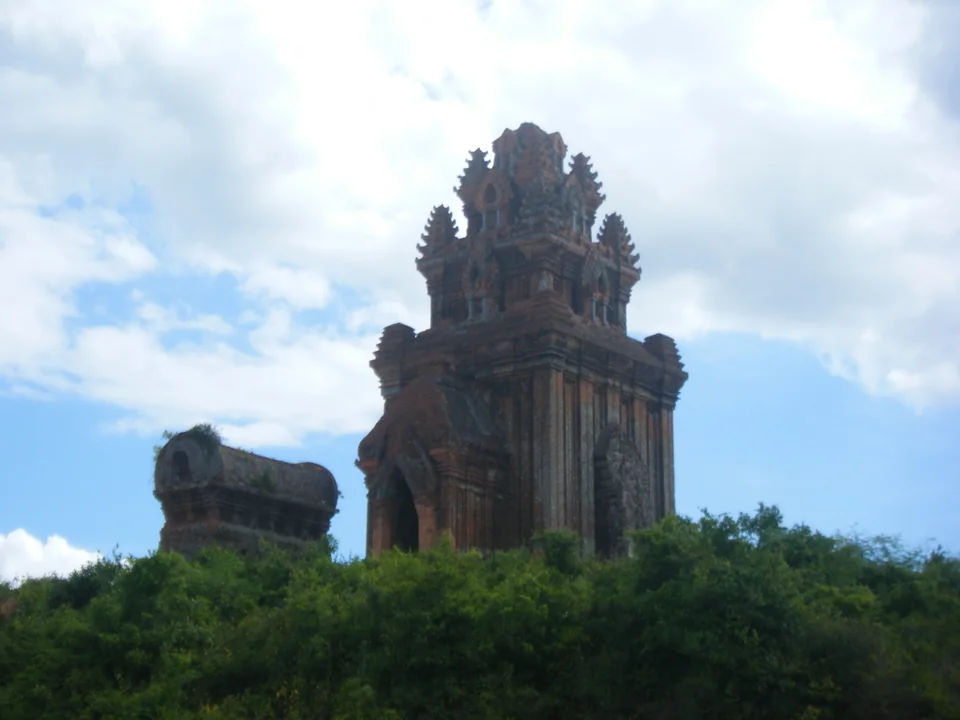
Cham tower architecture — Tháp Bánh Ít, Bình Định. ·
User: (WT-shared) Thrar at wts wikivoyage · CC BY-SA 3.0 · Resized and converted to WebP

Count four, then compare
Begin at an authorised viewpoint where you can understand the arrangement before moving among the buildings. The national tourism authority explicitly identifies four independent towers, each with a distinct architectural character. Instead of searching for the most impressive one immediately, compare a broad wall with a narrower profile, a roof shape with a doorway, and the spacing between structures. The group becomes more interesting when you notice those relationships. Keep the count of four in mind even when a particular angle hides one building behind another.
Let the hill shape your visit
Follow the marked or locally indicated approach and pause where the route allows. The changing elevation gives you more than a wider view: it alters how the towers line up against one another and against the surrounding landscape. On the way up, concentrate on the overall silhouettes; nearer the buildings, slow down for the texture of brickwork and decorative surfaces. Choose stable places to stand for photographs rather than walking backward while looking through a screen. There is no need to leave the visitor route to make the visit rewarding.
Look for architectural differences
Spend time with details that help distinguish one tower from its neighbours. Notice how openings, projecting surfaces and repeated ornament change the balance of a wall. If a carving is difficult to identify, record the question rather than supply a confident name. A local guide or museum explanation can add religious and historical context later. The pleasure of Banh It lies partly in this alternation between close observation and a return to the whole group, with the hill providing a shared setting for different forms.
Plan an excursion with breathing room
Arrange the outward journey and return to Quy Nhon together, allowing for walking, pauses and a meal rather than relying on an ambitious list of stops. Ask about the current entrance arrangements and the amount of climbing if anyone in your party has limited stamina. Bring drinking water and suitable footwear, and shorten the circuit if heat or rain makes the hill uncomfortable. Respect barriers and historic masonry. One carefully chosen additional heritage stop is enough; the four towers deserve space in the day of their own.
Ask VietnamGuide AI
Ask VietnamGuide AISources
- 1. vietnam.travel/node/1453
Source checked:
- 2. dulichquynhon.binhdinh.gov.vn/vi/thapbanhit
Source checked:
Explore more
- Ky Co Beach: give the coast time to reveal its colours
Discover Ky Co as a beach of pale sand and mountain edges, with a relaxed shore visit and a realistic choice between boat and road arrangements.
- Eo Gio: follow the wind and the curve of the rocks
Explore Eo Gio as a rocky coastal viewpoint, with a measured walk on open paths and time to watch the meeting of mountains and waves.
- Hon Kho: choose an island day from Nhon Hai
Plan a thoughtful Hon Kho boat outing from Nhon Hai, balancing the rocky island scenery, optional water activities and a clear return arrangement.