Travel guide
Gia Lai Provincial Museum: begin with the region’s story
For a cultural introduction within Quy Nhon, begin with Bảo tàng tỉnh Gia Lai, the Gia Lai Provincial Museum at 26 Nguyễn Huệ, phường Quy Nhơn. This current name and address are confirmed by the Ministry of Culture, Sports and Tourism in October 2026. Older travel material may call the institution the Bình Định museum; that name reflects the previous administrative setting. Knowing both labels helps you recognise the same Quy Nhon destination while keeping the current name clear in your travel plans.
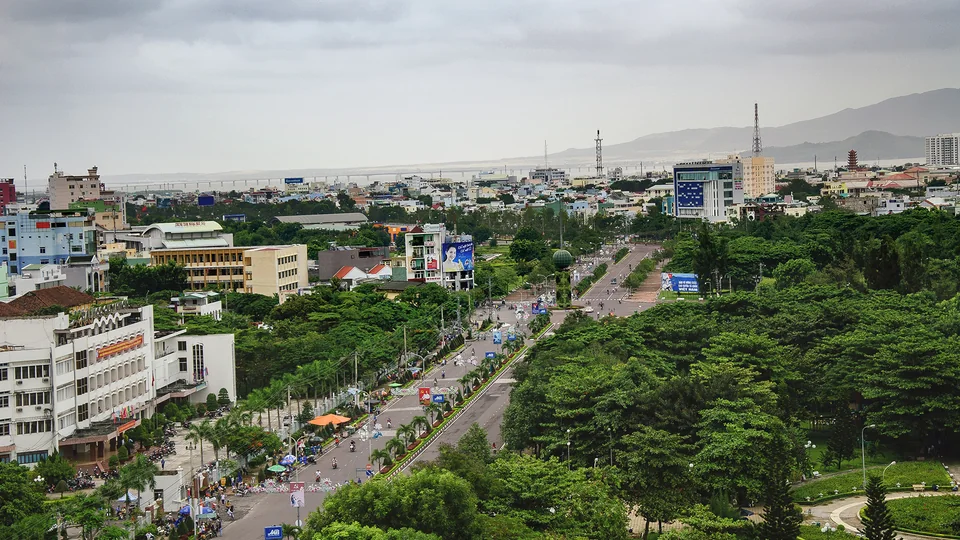
City view in an archival photograph from 2013 — Quy Nhơn. Regional context photograph from Quy Nhon–Binh Dinh. ·
Vũ Tuấn Quy Nhơn · CC BY 2.0 · Resized and converted to WebP

Start with objects and their origins
Rather than trying to see everything at once, choose a small group of Cham sculptures and read where they were found. The Ministry’s recent account identifies nationally recognised treasures connected with sites including Dương Long, Tháp Mẫm and Đồ Bàn. Provenance is a useful bridge between a museum object and the landscape outside the display room. A sculpture removed from its original setting is easier to understand when you retain the place name alongside the image, rather than remembering only an impressive shape.
Look closely at sculptural language
The documented collection includes a Brahma relief, Garuda figures subduing serpents and stone lions associated with Do Ban. These give you several ways to look: compare a human or divine figure with an animal form, then notice posture, repeated curves and the relation between carving and the stone surface. You need not arrive knowing the religious vocabulary. Read the available interpretation and let one object raise a question for the next. Avoid treating every unfamiliar figure as interchangeable simply because it belongs to the broad category of Cham art.
Use digital interpretation thoughtfully
The Ministry reports QR interpretation for the nationally recognised treasures, with Vietnamese and English text and audio as well as three-dimensional imagery. If these facilities are available during your visit, they can help with a detail that is difficult to see from the display position. Bring headphones if you intend to listen, keeping the room quiet for other visitors. Digital views are most useful when you return your attention to the actual object afterward, comparing what the explanation highlighted with what you can now recognise for yourself.
Make the museum your cultural starting point
Ask about current opening arrangements and the displays accessible on your chosen day. Begin with the museum before a tower excursion, or visit afterward to revisit questions raised by brick architecture and stone carving. Keep notes of a few place names, then choose one realistic outing from Quy Nhon rather than attempting every site represented in the collection. Observe photography instructions and leave display barriers undisturbed. A short, focused visit can give an inland heritage journey much more meaning without requiring an exhaustive lesson in regional history.
Ask VietnamGuide AI
Ask VietnamGuide AISources
Explore more
- Ky Co Beach: give the coast time to reveal its colours
Discover Ky Co as a beach of pale sand and mountain edges, with a relaxed shore visit and a realistic choice between boat and road arrangements.
- Eo Gio: follow the wind and the curve of the rocks
Explore Eo Gio as a rocky coastal viewpoint, with a measured walk on open paths and time to watch the meeting of mountains and waves.
- Hon Kho: choose an island day from Nhon Hai
Plan a thoughtful Hon Kho boat outing from Nhon Hai, balancing the rocky island scenery, optional water activities and a clear return arrangement.