Travel guide
Canh Tien Tower: reading the traces of Do Ban
Canh Tien invites a different kind of heritage visit: one surviving tower can prompt questions about a much larger historical landscape. Make the journey from Quy Nhon to the An Nhơn area, rather than expecting a monument in the coastal centre. The tower stands within the historic setting of Đồ Bàn, associated with the Cham capital of Vijaya. Its upward-reaching outline provides a clear visual starting point; the challenge and pleasure are to imagine that larger context without mistaking imagination for a reconstruction supported by evidence.
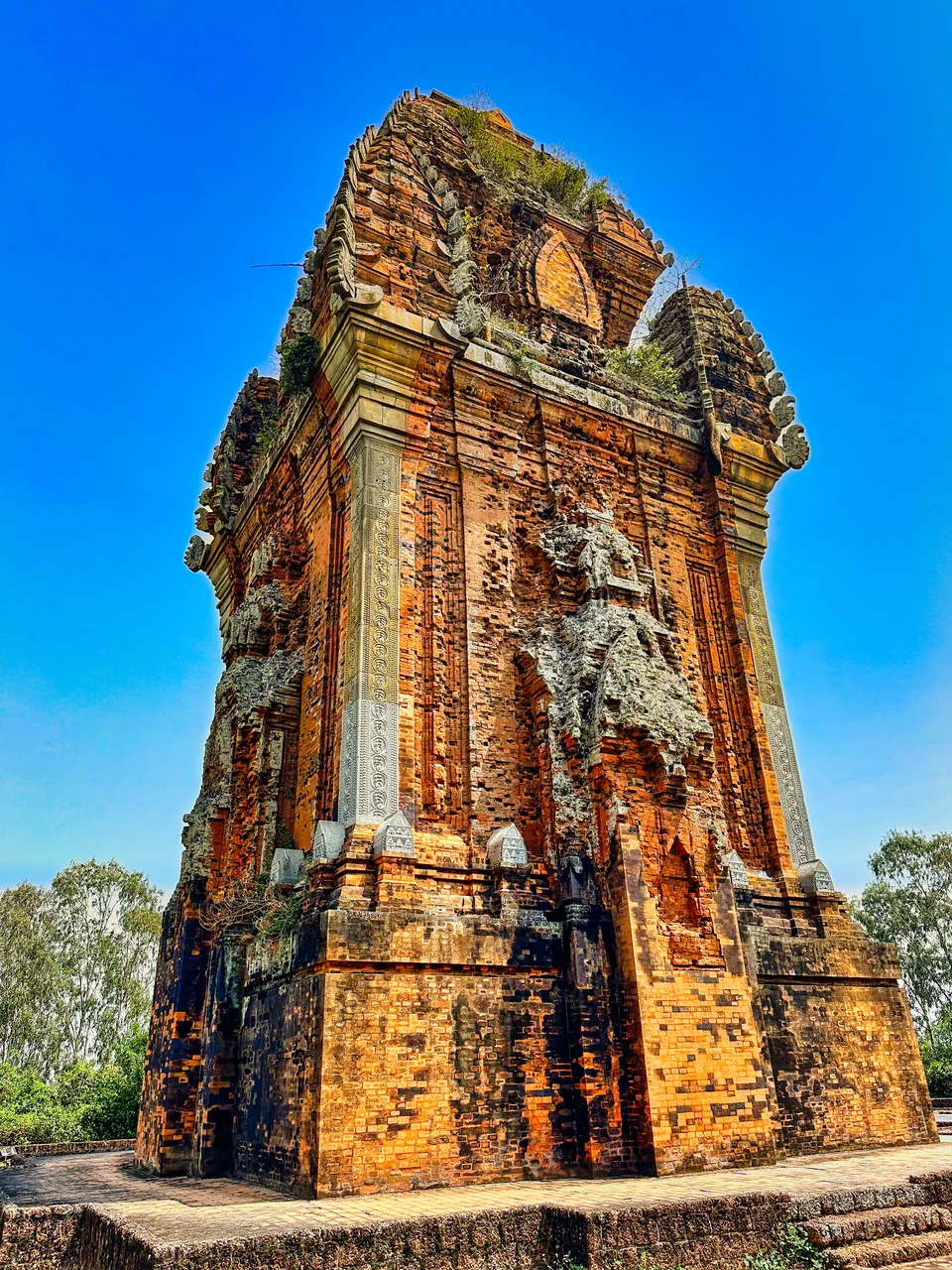
Cham tower architecture — Tháp Cánh Tiên, An Nhơn, Bình Định. ·
Ms Sarah Welch · CC0 1.0 · Resized and converted to WebP

Place the tower before naming the city
Begin by reading any site interpretation and locating the tower within the present visitor area. The national tourism authority places Canh Tien within Do Ban and describes it as a characteristic example of the Bình Định architectural style. Those historical names refer to a layered past, while An Nhon is your practical orientation for the excursion today. Resist expecting a completely preserved capital around the tower. A single surviving structure can carry historical meaning even when the original surroundings are difficult to read on the ground.
Follow the rising silhouette
Step back far enough, within the permitted area, to see how the tower narrows through its upper levels. The name Cánh Tiên evokes fairy wings, and the projecting corner details help explain that visual association. Let the shape guide your eye from the substantial lower body toward the more intricate upper outline. Compare the appearance from two viewpoints rather than treating the front view as the whole building. This gives the forms room to reveal their rhythm without requiring a close approach to fragile surfaces.
Find stone within the brick architecture
Official interpretation notes sandstone components in the wall pilasters and roof-corner decoration. That combination offers a useful question for close observation: where does brick establish the mass, and where does stone sharpen a line or carry an ornament? Look for vertical projections, changes of texture and the way shadows mark the edges. If a feature is hard to identify from the visitor route, keep it as a question for a guide. Touching a surface is not necessary to appreciate the difference between materials.
Link the visit thoughtfully
Allow time for the drive from Quy Nhon, the tower itself and a pause afterward. If you want a broader Do Ban context, arrange a guide or a carefully chosen additional heritage stop in advance, rather than following unmarked routes through surrounding land. Confirm the present entrance arrangements and permitted areas locally. Keep to public access, respect residents and avoid climbing historic masonry. Back in Quy Nhon, the provincial museum can help connect the architectural questions raised here with the region’s Cham sculpture and objects.
Ask VietnamGuide AI
Ask VietnamGuide AISources
- 1. vietnamtourism.vn/index.php/tourism/items/2062/3
Source checked:
- 2. vnmh.com.vn/vi/Articles/1508/50349/hoang-tan-thu-phu-tay-son.html
Source checked:
Explore more
- Ky Co Beach: give the coast time to reveal its colours
Discover Ky Co as a beach of pale sand and mountain edges, with a relaxed shore visit and a realistic choice between boat and road arrangements.
- Eo Gio: follow the wind and the curve of the rocks
Explore Eo Gio as a rocky coastal viewpoint, with a measured walk on open paths and time to watch the meeting of mountains and waves.
- Hon Kho: choose an island day from Nhon Hai
Plan a thoughtful Hon Kho boat outing from Nhon Hai, balancing the rocky island scenery, optional water activities and a clear return arrangement.