Travel guide
Duong Long Towers: a Cham architecture excursion
Duong Long rewards a deliberate journey inland from Quy Nhon. In the Tây Sơn area of the historic Bình Định region, now Gia Lai, three Cham towers provide a different architectural experience from an urban monument. Their scale is best understood by looking at the ensemble first and then examining the contrast between brick bodies and stone details. Set aside the temptation to compare disputed measurements or repeat a height record. The buildings offer plenty to discover through their materials, east-facing openings and sculptural upper forms.
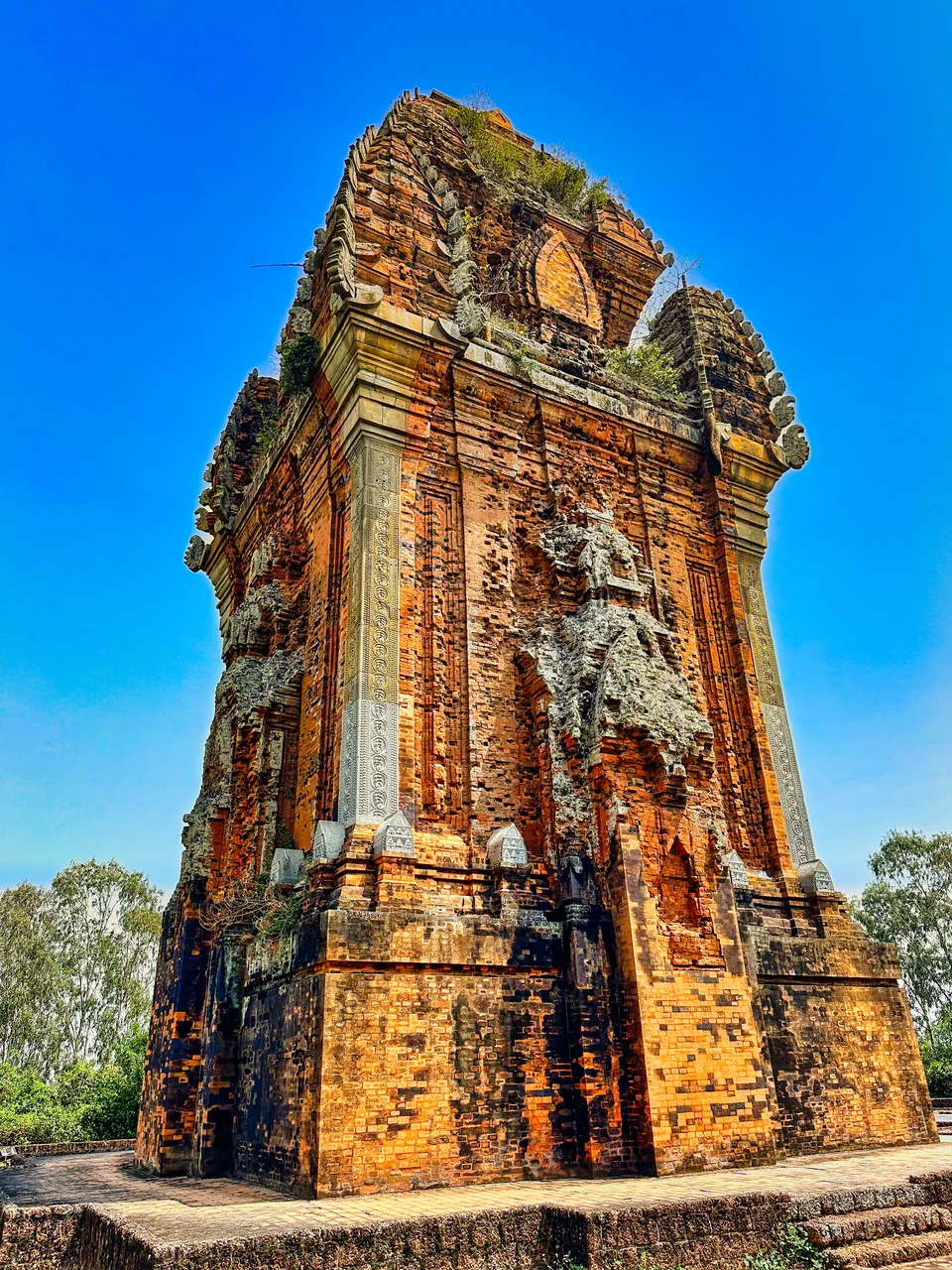
Cham tower architecture — Tháp Cánh Tiên, An Nhơn, Bình Định. Regional context photograph from Quy Nhon–Binh Dinh. ·
Ms Sarah Welch · CC0 1.0 · Resized and converted to WebP

Understand the group of three
Start with a view that includes all three towers from the authorised visitor area. Notice how the central building and its neighbours establish a rhythm, with open space helping define each volume. Both national tourism descriptions identify a three-tower ensemble. This simple fact is a better orientation than concentrating immediately on a single dramatic photograph. Walk only where permitted, allowing changes of angle to show you how the outlines overlap and how each building holds its place within the group.
Where brick meets stone
The national destination description notes brick tower bodies combined with large stone elements and carved stone decoration. Look for that change of material rather than treating the surface as a uniform reddish mass. At a doorway, a corner or a higher decorative zone, consider how a hard edge, a shadow and a carved form draw the eye differently. The east-facing entrances are another useful reference point. Observe them from the public route without assuming that an opening is an invitation to enter or climb.
Lift your eyes to the ornament
Among the imagery recorded by the tourism authority are Garuda and other animal forms, while lotus shapes crown the upper architecture. You do not have to identify every figure to enjoy the work. Try following one repeating line or comparing the treatment of a corner with a flat wall. A distant detail may be easier to revisit in a photograph than to approach physically. If travelling with a guide, ask how stone carving contributes to the religious meaning of the towers, and which interpretations are firmly documented.
Give Tay Son a proper day
Arrange this as an excursion from Quy Nhon with a clear return plan, a meal stop and enough time to look without rushing. The Quang Trung Museum can provide a contrasting historical subject if your transport and available time make the combination reasonable. Check entrance conditions and current site access before committing to the route. Carry water, allow breaks in the heat and respect all barriers around vulnerable masonry. A shorter, attentive visit is more satisfying than adding another distant stop simply to complete a list.
Ask VietnamGuide AI
Ask VietnamGuide AISources
- 1. vietnamtourism.vn/index.php/tourism/items/1342
Source checked:
- 2. vietnam.travel/node/1453
Source checked:
Explore more
- Ky Co Beach: give the coast time to reveal its colours
Discover Ky Co as a beach of pale sand and mountain edges, with a relaxed shore visit and a realistic choice between boat and road arrangements.
- Eo Gio: follow the wind and the curve of the rocks
Explore Eo Gio as a rocky coastal viewpoint, with a measured walk on open paths and time to watch the meeting of mountains and waves.
- Hon Kho: choose an island day from Nhon Hai
Plan a thoughtful Hon Kho boat outing from Nhon Hai, balancing the rocky island scenery, optional water activities and a clear return arrangement.