Travel guide
Ghenh Rang–Tien Sa: read a coast of stone, sea and hill
Ghenh Rang–Tien Sa brings the scale of a hillside and the detail of a rocky shore together near Quy Nhon. It works best as a landscape visit with several pauses rather than a race around separate photo points. Let the changing relationship of stone, slope and sea guide the outing, while leaving the poet’s memorial and Queen Beach their own distinct stories.
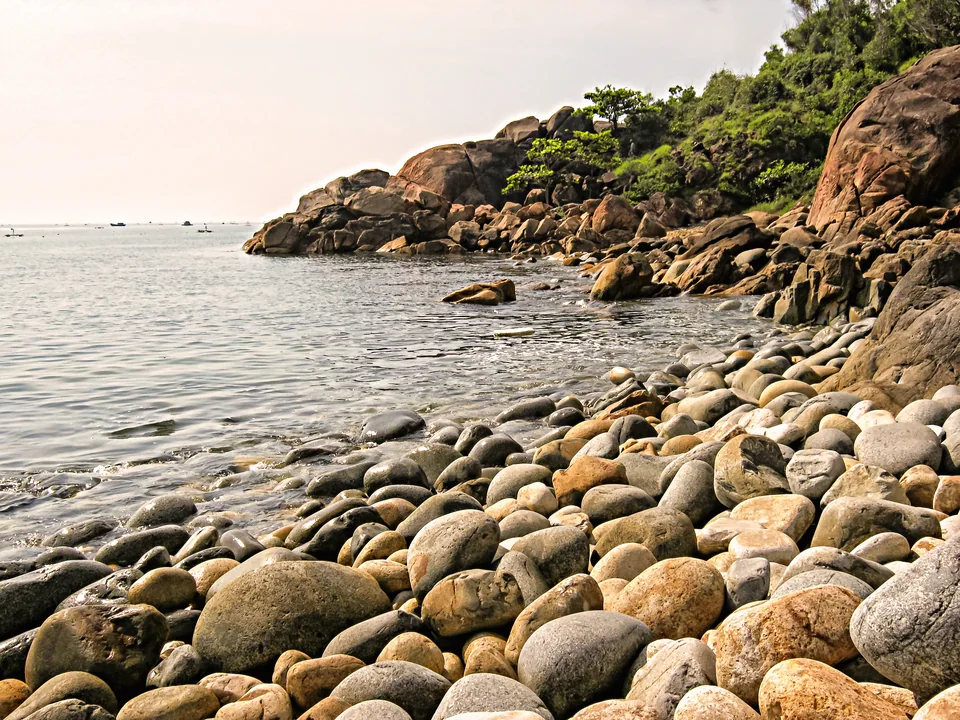
Coast with rounded stones — Bãi Đá Trứng, Ghềnh Ráng, Quy Nhơn.
Thuydaonguyen · CC BY-SA 3.0 · Resized and converted to WebP

Begin with the whole landscape
The official destination description presents Ghenh Rang as successive rocky shores following the curve of Xuan Van’s slopes. Start by seeing that overall shape from an open visitor area: where the hillside descends, where the rocks interrupt the water and where the city’s wider beach appears beyond. A broad view makes the smaller details easier to place later. The attraction is not only a single named rock. It is the way uneven stone, vegetation and the sea fit into one continuous scene, with the urban coast close enough to remain part of the picture.
Follow the hillside’s changing frames
Walk the open paths at a pace that lets the view change naturally. One pause can be about the near rocks and the lines between them; the next can let the sea occupy most of the frame. Try looking back as well as ahead, because a familiar piece of coastline can feel different when seen from the opposite direction. Sun and cloud create different versions of the same slopes, so a successful visit does not depend on blue water or dramatic light. Stay on the visitor route instead of using rocks as steps to reach an isolated angle.
Read the human layer quietly
This is also a cultural landscape, with the memorial setting of poet Han Mac Tu within the wider complex. If you include it, change your pace and treat it as a place of remembrance rather than another scenic prop. Reading a name or a short piece of interpretation can provide a useful human counterpoint to the sea view. Queen Beach is another specific part of the area, known for rounded stones; save its close observation for a separate pause rather than letting it stand for the whole of Ghenh Rang.
Choose a route with a satisfying return
Before walking, confirm which paths are open and choose a turnaround that fits the group’s energy. Hillside routes and steps can make a short map distance feel longer, particularly in heat, so leave room for a drink and a rest. Arrange the return pickup at an accessible, permitted point rather than expecting a vehicle beside every viewpoint. After the walk, a simple meal back towards town can complete the outing. The aim is to leave with a sense of how the landscape fits together, not with proof that every path has been covered.
Ask VietnamGuide AI
Ask VietnamGuide AISources
- 1. csdl.vietnamtourism.gov.vn/dest/
Source checked:
Explore more
- Ky Co Beach: give the coast time to reveal its colours
Discover Ky Co as a beach of pale sand and mountain edges, with a relaxed shore visit and a realistic choice between boat and road arrangements.
- Eo Gio: follow the wind and the curve of the rocks
Explore Eo Gio as a rocky coastal viewpoint, with a measured walk on open paths and time to watch the meeting of mountains and waves.
- Hon Kho: choose an island day from Nhon Hai
Plan a thoughtful Hon Kho boat outing from Nhon Hai, balancing the rocky island scenery, optional water activities and a clear return arrangement.