Travel guide
Ngoc Hoa Monastery: a quiet stop in Nhon Ly
Ngọc Hòa belongs to the cultural landscape of Nhơn Lý, a coastal village reached on an excursion from central Quy Nhon. The national tourism authority includes the monastery among the village’s cultural stops, while its destination database identifies the prominent two-sided Quan Âm image. Those facts suggest a visit with a clear focus: a living Buddhist setting within a fishing community, rather than another beach viewpoint. Give the monastery its own quiet interval instead of treating it as a quick photograph on the way to the coast.
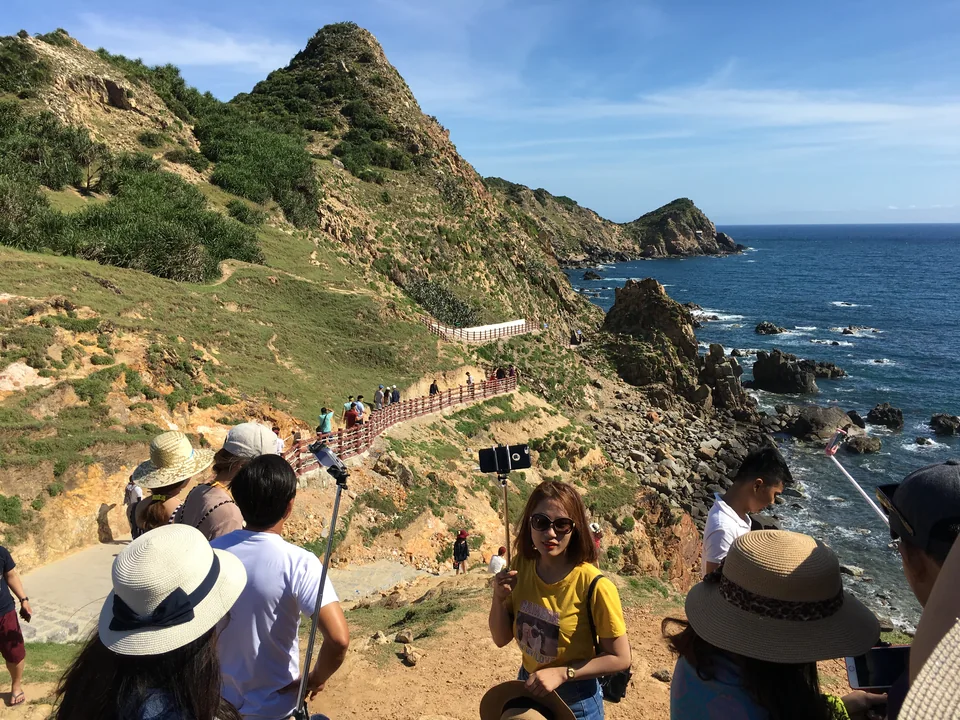
Walkway along a rocky coast — Eo Gió, Nhơn Lý, Quy Nhơn. Regional context photograph from Quy Nhon–Binh Dinh. ·
Trường Sơn · CC0 1.0 · Resized and converted to WebP

Arrive with the village in mind
The monastery makes more sense when understood as part of Nhon Ly rather than detached from its surroundings. Approach by the permitted public route and leave space for residents, worshippers and people going about ordinary work. The national tourism account connects the village’s visitor experiences with its maritime culture and local heritage. That context does not turn every lane or doorway into a tourist attraction. A respectful arrival, with a clear destination and a restrained camera, helps preserve the difference between a welcome visit and an intrusion into daily life.
Look at the paired Quan Am image
The large two-sided Quan Am image is the clearest visual reference for this particular monastery. Begin from an authorised viewing position and observe how the paired form is composed, rather than measuring the visit by a superlative or a claimed height. Quan Am is a devotional figure, so let the religious context guide your looking. If interpretation is available, ask about the meaning of the images and listen to the stories connecting them with the coastal community. A photograph can record the form without requiring access to the inside of a monument.
Notice smaller spaces as well
After the prominent image, shift attention to the spaces in which people actually pause, pray or move between buildings. Watch the relationship between open ground, sheltered areas and religious objects where visitors are permitted. This change from the monumental to the ordinary gives the visit texture. You do not need to enter every hall or follow someone carrying out a religious duty. If a space is closed or in use, remain outside and use the pause to look at the overall setting instead.
Keep a coastal day balanced
Check current visitor access, dress respectfully and follow local guidance on shoes, photography and silence. Ngoc Hoa can provide a quieter element in a Nhon Ly outing, alongside a village meal or another permitted coastal stop. It is distinct from Ong Nui, which is a different religious excursion, and from Nhon Hai, which is a different village. Plan transport back to Quy Nhon before lingering, and leave a comfortable margin for the return. The monastery deserves attention as a place of practice, not a guaranteed programme or a scheduled performance.
Ask VietnamGuide AI
Ask VietnamGuide AISources
Explore more
- Ky Co Beach: give the coast time to reveal its colours
Discover Ky Co as a beach of pale sand and mountain edges, with a relaxed shore visit and a realistic choice between boat and road arrangements.
- Eo Gio: follow the wind and the curve of the rocks
Explore Eo Gio as a rocky coastal viewpoint, with a measured walk on open paths and time to watch the meeting of mountains and waves.
- Hon Kho: choose an island day from Nhon Hai
Plan a thoughtful Hon Kho boat outing from Nhon Hai, balancing the rocky island scenery, optional water activities and a clear return arrangement.