Travel guide
Phuong Mai Sand Dunes: light, lines and a manageable walk
Phuong Mai adds a very different texture to Quy Nhon’s coastal scenery. On the peninsula beyond Thi Nai Lagoon, sand rises in pale curves between the sky and the surrounding landscape. The attraction is not necessarily a strenuous climb or an organised activity. A short walk on an authorised section can be enough to appreciate wind-shaped lines, footprints and the way a slope changes colour.
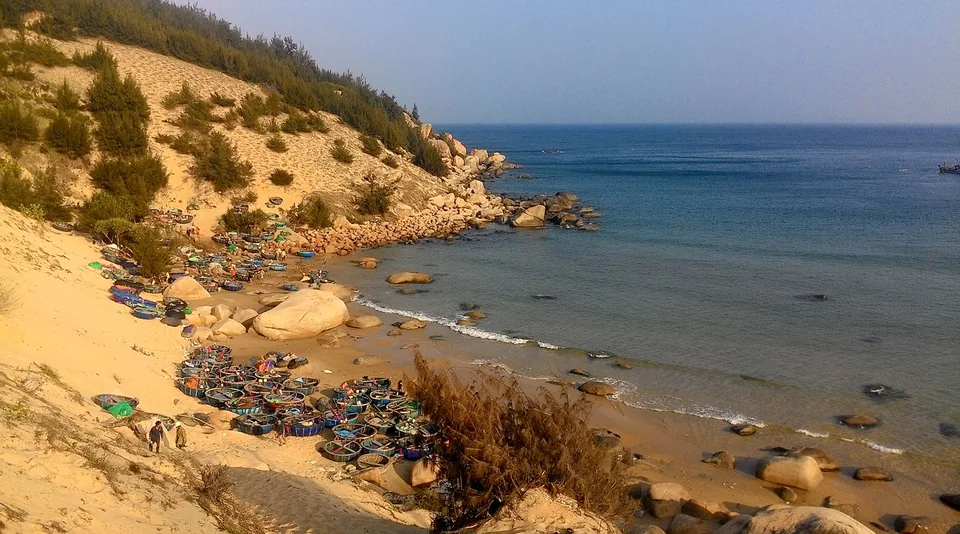
Coast with small boats — Quy Nhơn. Regional context photograph from Quy Nhon–Binh Dinh. ·
VeeWin · CC BY-SA 4.0 · Resized and converted to WebP

Begin with the shape of the peninsula
The national tourism database describes Phuong Mai to the east of Thi Nai, with rocky hills and large dunes. Keep that larger setting in mind as you arrive: this is a peninsula landscape, not an isolated desert. Arrange a currently permitted dune access point with your driver or local host, including a lawful place for the vehicle to wait. From the entrance, look at the relation between nearby scrub, the first sandy slope and the horizon before deciding how far to walk.
Follow light with your eyes
Choose one clear ridge or gently sloping face as your subject. Look at it from several positions within the permitted area: a low view brings out ripples, while a wider frame shows the sweep of sand. Side light may make small ridges more visible, but clouds can create softer tones that are just as appealing. Let the conditions suggest the photograph rather than expecting a particular golden-hour effect. Leave vegetation intact and avoid crossing fragile plants simply to remove something from the frame.
Keep the walk comfortably short
Walking uphill through loose sand takes more effort than the same distance on pavement. Start with a modest out-and-back route whose return remains obvious, and pause to look behind you as you go. Families can turn the visit into an exercise in finding patterns: a ripple, a footprint, a line where sand meets plants. There is no need to reach the tallest crest. Sandboarding should only be considered if a legitimate provider actually offers it under suitable conditions; old photographs do not establish a current service.
Combine one dune stop with the coast
A manageable plan pairs a confirmed dune stop with a meal or another nearby peninsula destination, leaving a rest between activities. Carry water, sun protection and footwear appropriate for hot or uneven sand; check the wind before taking out delicate camera equipment. Avoid entering fenced land, construction areas or unmarked routes suggested by old posts. Agree on the pickup location before leaving the vehicle. A successful visit can be brief: a few well-chosen views and enough energy left to enjoy the rest of the day.
Ask VietnamGuide AI
Ask VietnamGuide AISources
- 1. csdl.vietnamtourism.gov.vn/dest/
Source checked:
- 2. dulichquynhon.binhdinh.gov.vn/ja/detailnews/
Source checked:
Explore more
- Ky Co Beach: give the coast time to reveal its colours
Discover Ky Co as a beach of pale sand and mountain edges, with a relaxed shore visit and a realistic choice between boat and road arrangements.
- Eo Gio: follow the wind and the curve of the rocks
Explore Eo Gio as a rocky coastal viewpoint, with a measured walk on open paths and time to watch the meeting of mountains and waves.
- Hon Kho: choose an island day from Nhon Hai
Plan a thoughtful Hon Kho boat outing from Nhon Hai, balancing the rocky island scenery, optional water activities and a clear return arrangement.