Travel guide
Queen Beach: look closely at Ghenh Rang’s rounded stones
Queen Beach, or Bai tam Hoang Hau, is a specific rocky shore within Ghenh Rang. Its rounded stones give it the familiar association with eggs, making close observation more rewarding than simply checking off another beach name. Come for shape, texture and the changing edge of the water; the word “beach” does not promise conditions suitable for bathing.
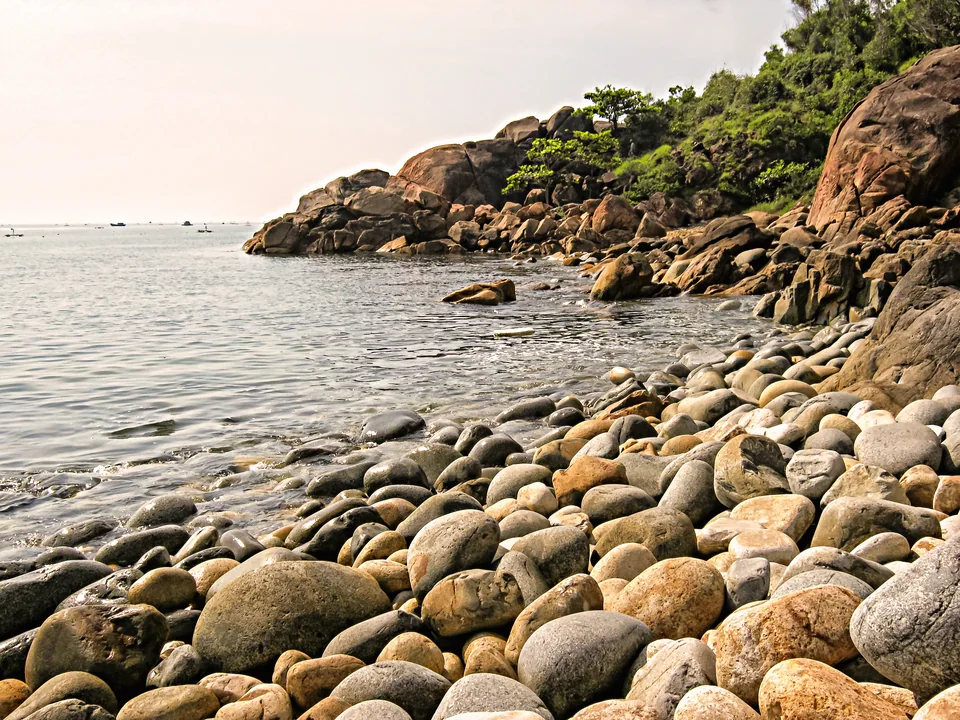
Coast with rounded stones — Bãi Đá Trứng, Ghềnh Ráng, Quy Nhơn.
Thuydaonguyen · CC BY-SA 3.0 · Resized and converted to WebP

Find the detail within Ghenh Rang
Begin from an open visitor viewpoint and locate the band of rounded stones before deciding how much farther to go. This is one part of the wider scenic area, not another name for the entire complex. A first broad look helps show how the stone-covered shore sits beneath the hillside and beside the sea. Then narrow your attention: different sizes, the spaces between them and the contrast with more angular rock nearby. You do not need to step onto every surface to understand the pattern or to make an interesting photograph.
Watch how the stones change with light
Choose a small group of stones to watch for a few minutes. Wet surfaces can seem darker, while drier ones reveal a different texture; passing cloud changes the strength of both. A wave may briefly join separate shapes with foam before draining away and revealing the gaps again. This is a small-scale landscape, so let the framing become simple. A photograph from the authorised route can place a few rounded forms against a strip of water, while a wider frame brings the hillside back into the story. Neither needs a person balanced on the rocks.
Read the royal name with care
Official tourism information links the beach’s name with a story about Empress Nam Phuong choosing it during visits with Emperor Bao Dai. Treat that as the naming tradition presented by the destination description, rather than using it to invent royal buildings, private rituals or precise historical scenes. The tangible interest remains the shore itself. If you have already walked through Ghenh Rang, this pause adds detail to its larger landscape; it need not repeat the separate visit to Han Mac Tu’s memorial or turn into a general history tour.
Leave the shore as you found it
Keep stones where they are and do not stack them or carry one away as a souvenir. Use the route and viewing areas currently open to visitors, staying clear of wave-washed rock and avoiding informal descents. Rounded, wet surfaces can be difficult underfoot; viewing from a secure place may be the best choice for a mixed-ability group. Ask locally about current restrictions and do not infer swimming permission from the traditional beach name. End with a final look at the whole shore: the quieter reward is noticing a pattern that was easy to miss on arrival.
Ask VietnamGuide AI
Ask VietnamGuide AISources
- 1. csdl.vietnamtourism.gov.vn/dest/
Source checked:
Explore more
- Ky Co Beach: give the coast time to reveal its colours
Discover Ky Co as a beach of pale sand and mountain edges, with a relaxed shore visit and a realistic choice between boat and road arrangements.
- Eo Gio: follow the wind and the curve of the rocks
Explore Eo Gio as a rocky coastal viewpoint, with a measured walk on open paths and time to watch the meeting of mountains and waves.
- Hon Kho: choose an island day from Nhon Hai
Plan a thoughtful Hon Kho boat outing from Nhon Hai, balancing the rocky island scenery, optional water activities and a clear return arrangement.