Travel guide
Visiting the Cao Dai Holy See: architecture and respectful access
The Cao Dai Holy See in Hoa Thanh is an active religious complex as well as an architectural landmark. Approach it as a place of worship: confirm where visitors may enter, follow attendants’ directions and treat any ceremony as worship rather than a performance.
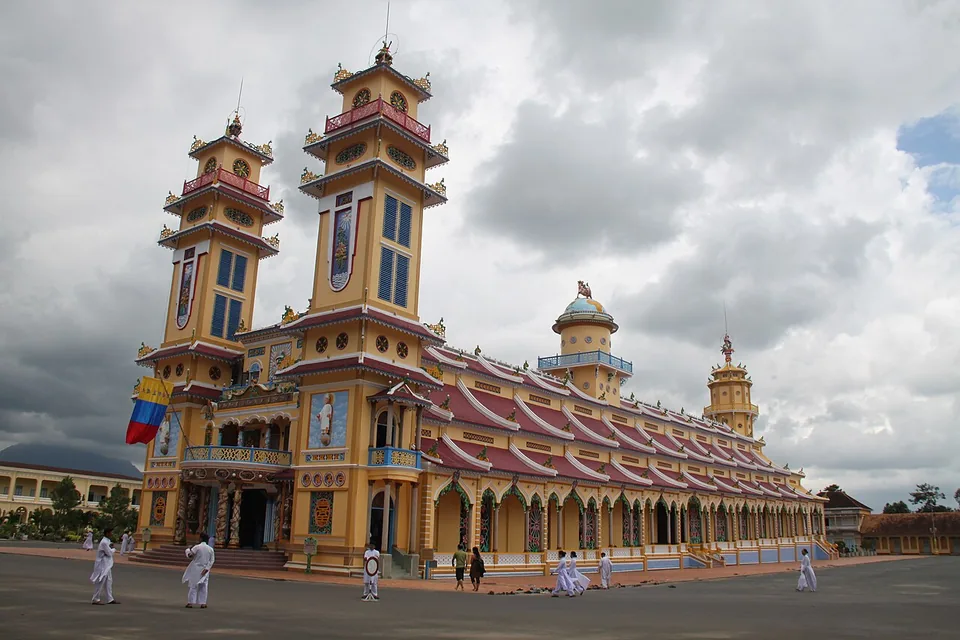
Facade of the Cao Dai Holy See in Tay Ninh — Historical photograph; not evidence of current facilities, operating schedule or travel-day conditions.
Gary Todd from Xinzheng, China / Wikimedia Commons / CC0; resized and converted to WebP · CC0 1.0 · Resized and converted to WebP

Locate the correct site
The provincial tourism portal gives the Holy See on Pham Ho Phap street in present-day Hoa Thanh ward, while older addresses may still appear online. Use the exact site pin rather than the name of the enlarged province alone. Cao Dai is a distinct religion; do not label its clergy or ceremonies as Buddhist.
Look closely without oversimplifying
The building’s towers, colour and symbolic details reward an unhurried visit. Read available explanations or ask an authorised guide instead of guessing that every decorative feature represents the same tradition. The official provincial account dates construction from 1933 to completion in 1955; avoid combining this with unsupported claims about other buildings in the complex.
Follow the visitor route during worship
Remove shoes where instructed and use the entrances and areas indicated by attendants. Ask about permitted photography and whether a ceremony affects access that day. Do not assume a published ceremony time guarantees visitor admission or a particular viewpoint. Keep voices low and avoid crossing prayer lines or obstructing worshippers for a photograph.
Plan a considered cultural stop
Keep the visit flexible if access is temporarily restricted: the permitted exterior may still provide an architectural introduction. A child or tired companion can rest outside with another adult rather than interrupt the service. Combine the Holy See with nearby plans only after checking the actual transfer, and keep it distinct from Buddhist sites such as Go Ken pagoda.
Ask VietnamGuide AI
Ask VietnamGuide AISources
Explore more
- Dau Tieng Reservoir: choose a responsible shore visit
Plan a Dau Tieng Reservoir outing with a confirmed shore access point, weather alternatives and practical water-safety checks.
- Lo Go–Xa Mat National Park: plan an authorised nature visit
Arrange a Lo Go–Xa Mat outing through the park, with an approved route, realistic wildlife expectations and a return plan.
- Tay Ninh shrimp salt and food gifts: check the ingredients
Choose Tay Ninh shrimp salt and food souvenirs by ingredient list, packaging, storage instructions and the traveller’s dietary needs.