Travel guide
Dong Khanh Tomb: architectural layers in one complex
Dong Khanh Tomb, also called Tu Lang, does not present a single design made at one moment. Its worship buildings and burial area developed through different phases. The reward is seeing architectural change within one complex, rather than assigning every wall and roof to the emperor whose name appears at the entrance.
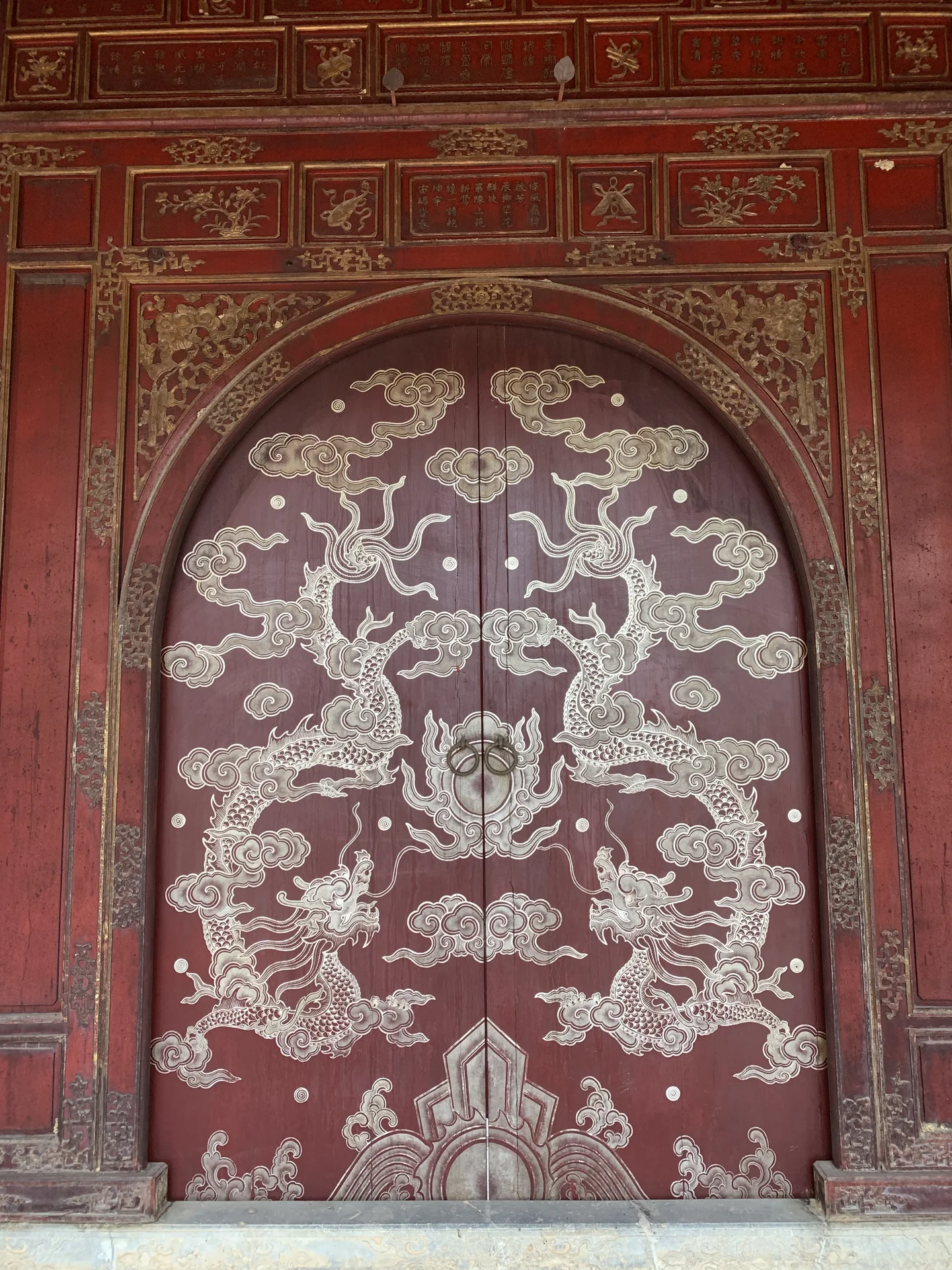
A dragon-decorated wooden door at Dong Khanh Tomb. ·

Begin with the change of purpose
Dong Khanh commissioned Truy Tu temple to honour his father, Kien Thai Vuong. After the emperor’s death, his successor Thanh Thai adapted the building as Ngung Hy for Dong Khanh’s worship. Later, Dong Khanh’s son Khai Dinh undertook further work on the temple and funerary area. This sequence matters more than memorising a list of completion dates: the complex grew through changed needs and family remembrance. Ask a guide to distinguish the origins of the worship building from the later work on the burial architecture before comparing decorative styles.
Compare craft and architectural language
Ngung Hy retains a traditional courtly vocabulary of timber, red lacquer and gilding. Its decorative panels include plants, birds and scenes associated with filial piety. The funerary area introduces a stronger European influence, and the stele pavilion combines forms associated with Romanesque and East Asian architecture. Compare the treatment of supports, rooflines and surfaces across the two areas rather than deciding that the entire place is either traditional or European. The interesting evidence is in their coexistence: different materials and design ideas meet without all belonging to the same original commission.
Plan for a comparison within the site
A visit is most useful when it gives attention to both the temple and the funerary zone. Ask which interiors and exterior areas are currently accessible, then choose a guide who can explain how the phases connect. Do not assume an old restoration report guarantees present entry to every room or the display of particular objects. If combining Dong Khanh with another tomb, keep enough time here to compare the two architectural settings instead of treating it as an extra photograph stop. Its distinctive story is the adaptation of a family memorial and the changing forms used to commemorate an emperor.
Ask VietnamGuide AI
Ask VietnamGuide AISources
- 1. huetourism.gov.vn/tu-lang-lang-vua-dong-khanh/
Source checked:
Explore more
- Perfume River: choose your kind of boat experience
See Hue from the Perfume River and understand the difference between sightseeing, Ca Hue listening and dining afloat.
- Truong Tien Bridge: see Hue from both riverbanks
Read the steel curves and layered history of Truong Tien Bridge, then choose a riverfront walk that reveals Hue from different angles.
- Dong Ba Market: understand Hue through everyday trade
Explore Dong Ba's food, clothing and gift trade on the north bank of the Perfume River, with thoughtful choices for a market visit.