Travel guide
Gia Long Tomb: understand the Thien Tho landscape
Gia Long Tomb is best understood as a landscape containing buildings, rather than a building with scenery around it. Thien Tho is associated with the founding emperor of the Nguyen dynasty, but its wider setting includes other royal family tombs. Scale and relationships matter as much as decorative detail.
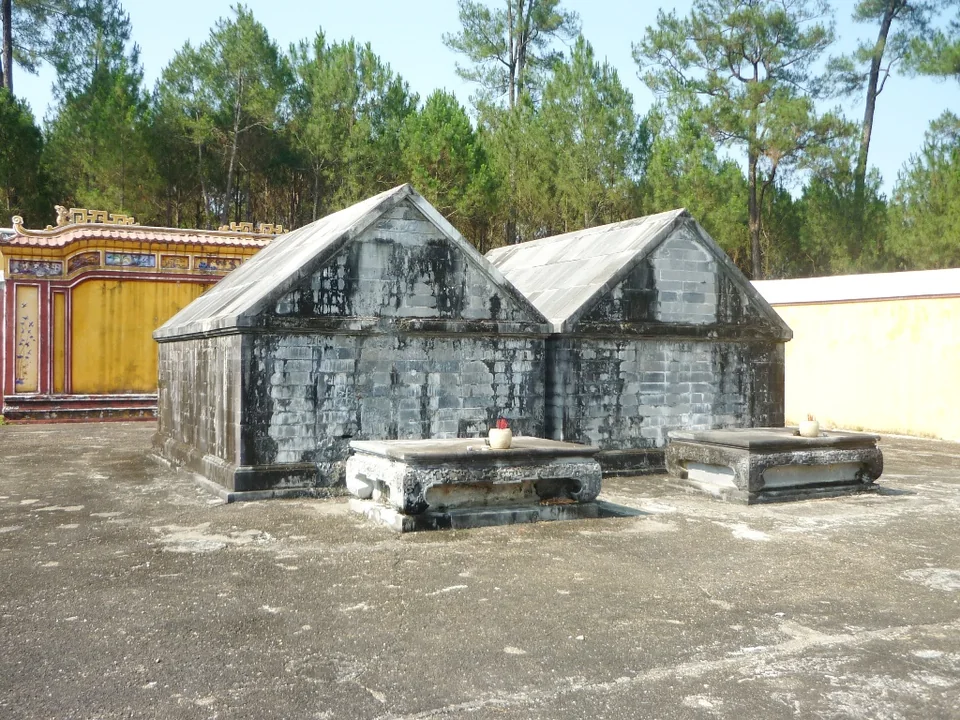
Paired tomb structures at the Gia Long mausoleum. ·
BluesyPete · CC BY-SA 3.0 · Resized and converted to WebP

Let the hills frame the monument
The main mausoleum developed between 1814 and 1820, following the death of Empress Thua Thien. Dai Thien Tho hill provides the principal foreground feature, with surrounding hills contributing to the planned setting. Look at the profile beyond the courts before concentrating on masonry: this is a design in which the terrain carries much of the effect. The contrast between a relatively restrained built form and the larger landscape is worth observing in its own right, without needing to describe the place as empty, undiscovered or always peaceful.
Two tombs and a family landscape
Within the main burial enclosure are the paired stone tombs of Gia Long and Empress Thua Thien. Minh Thanh temple serves their worship, while the stele records a text by their successor Minh Mang honouring his father. These are different functions within the complex, not interchangeable monuments. The wider Thien Tho area also includes Thien Tho Huu, associated with Empress Thuan Thien, Minh Mang’s mother. Keeping Thua Thien and Thuan Thien distinct prevents two similar names from obscuring the family relationships that help explain the landscape.
Agree on the extent of the visit
Because the name Gia Long Tomb can refer to a broader complex, ask a guide which areas the outing actually covers. A focused visit to the principal mausoleum and an expanded royal-family landscape visit are not necessarily the same walk. Confirm the present entrance, vehicle meeting point and any internal transport directly, rather than following an old description of a bridge, river crossing or path. Leave time to understand the connection between the paired tombs, temple and hills. This site suits travellers interested in landscape and dynastic beginnings, especially when the interpretation explains the relationships rather than merely naming each structure.
Ask VietnamGuide AI
Ask VietnamGuide AISources
- 1. huetourism.gov.vn/lang-vua-gia-long-thien-tho-lang-uy-nghiem/
Source checked:
- 2. vietnam.travel/things-to-do/an-inside-guide-hue-tombs
Source checked:
Explore more
- Perfume River: choose your kind of boat experience
See Hue from the Perfume River and understand the difference between sightseeing, Ca Hue listening and dining afloat.
- Truong Tien Bridge: see Hue from both riverbanks
Read the steel curves and layered history of Truong Tien Bridge, then choose a riverfront walk that reveals Hue from different angles.
- Dong Ba Market: understand Hue through everyday trade
Explore Dong Ba's food, clothing and gift trade on the north bank of the Perfume River, with thoughtful choices for a market visit.