Travel guide
Minh Mang Tomb: architecture between lakes and hills
Minh Mang Tomb, also called Hieu Lang, turns an imperial mausoleum into an ordered landscape. Gates, courts, worship buildings and water create a measured progression rather than a single architectural climax. The rewarding question is how the parts hold their relationship as you move between them.
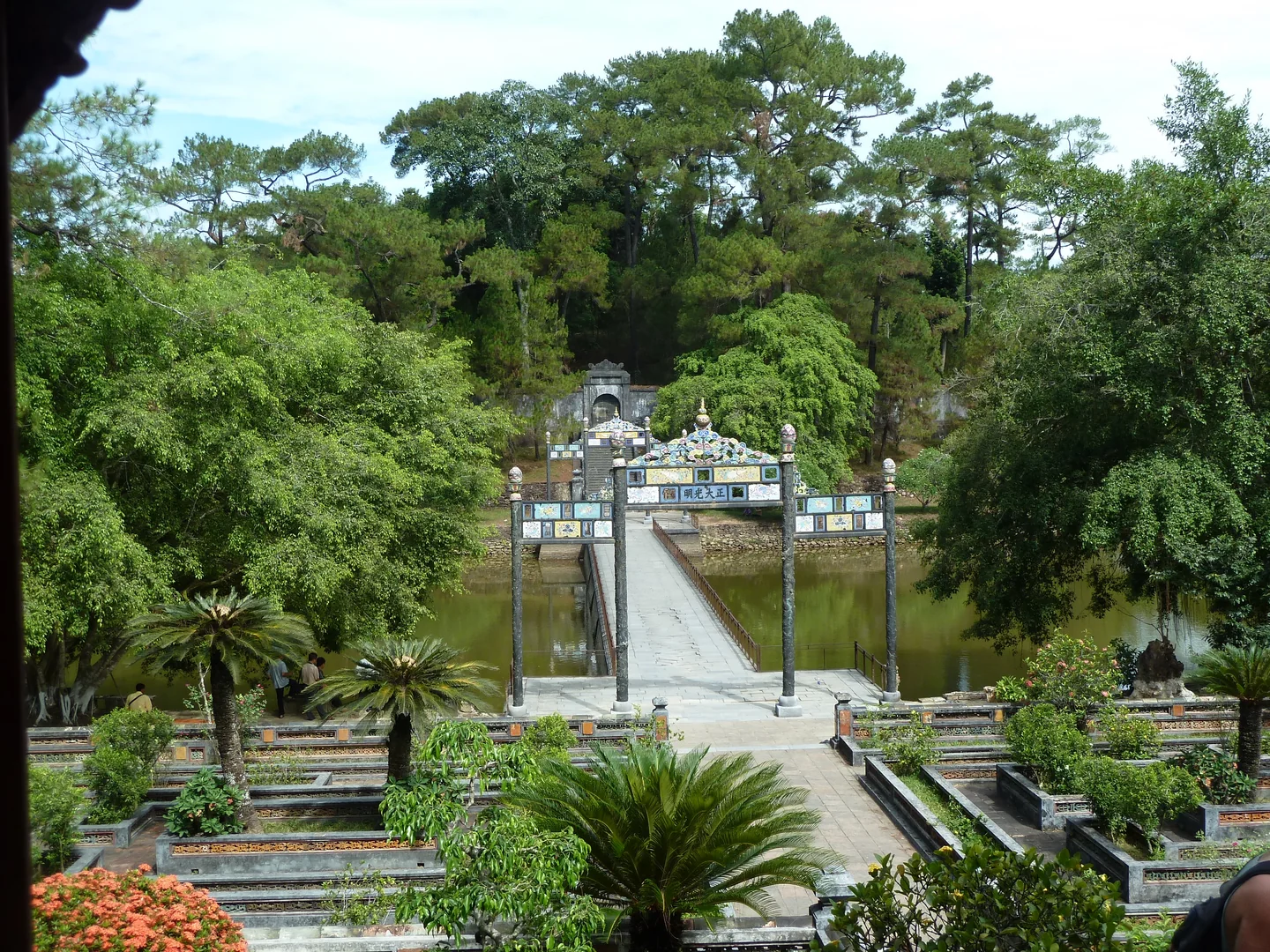
Gates and a path across water at Minh Mang Tomb. ·
lightwrite on Flickr · CC BY-SA 2.0 · Resized and converted to WebP

Find the line through the landscape
The principal buildings follow a ceremonial axis with paired elements on either side. Beyond the entrance area, the court’s stone officials, elephants and horses establish a formal register; the stele pavilion adds a written account of the emperor’s life by his successor, Thieu Tri. Sung An temple belongs to the worship area, reminding you that a royal tomb includes ritual buildings as well as a burial place. Look along the centre, then glance sideways: the arrangement becomes clearer when you compare the main line with its balanced flanking structures.
Let water change the scale
Trung Minh Lake and its bridges lead the composition towards Minh Lau, the square, two-storey pavilion on Tam Tai hill. Farther along, crescent-shaped Tan Nguyet Lake curves around the burial enclosure. Straight architectural lines and curved water edges give the place two different visual rhythms. Try looking at the pavilion as part of the hill and lake before isolating its roof in a photograph. A pause at this transition can reveal more about the design than moving straight from one named building to the next without looking back.
Choose a visit that explains the sequence
Construction began during Minh Mang’s lifetime and was completed under Thieu Tri in 1843. That history helps separate the emperor’s planning from his successor’s work. A guide who explains the axis, worship area and lake setting offers more than a ranking among Hue’s tombs. Ask how the actual walk covers these elements and where the group meets its vehicle afterwards. Confirm current entry arrangements, steps and any restricted areas with the site or provider; the designed axis is not a promise that every gate or burial enclosure is open to visitors.
Ask VietnamGuide AI
Ask VietnamGuide AISources
- 1. huetourism.gov.vn/Net-kien-truc-lam-me-hoac-long-nguoi-cua-lang-Minh-Mang.html/
Source checked:
- 2. vietnam.travel/things-to-do/an-inside-guide-hue-tombs
Source checked:
- 3. whc.unesco.org/en/activities/318/
Source checked:
Explore more
- Perfume River: choose your kind of boat experience
See Hue from the Perfume River and understand the difference between sightseeing, Ca Hue listening and dining afloat.
- Truong Tien Bridge: see Hue from both riverbanks
Read the steel curves and layered history of Truong Tien Bridge, then choose a riverfront walk that reveals Hue from different angles.
- Dong Ba Market: understand Hue through everyday trade
Explore Dong Ba's food, clothing and gift trade on the north bank of the Perfume River, with thoughtful choices for a market visit.