Travel guide
Nam Giao Esplanade: read the space of imperial ritual
Nam Giao asks you to look at space rather than search for a grand interior. This open-air ritual site south of the Citadel shows another aspect of imperial Hue: the ruler’s ceremonial relationship with Heaven, Earth and the human world. Its meaning becomes clearer when the ground plan is part of what you come to see.
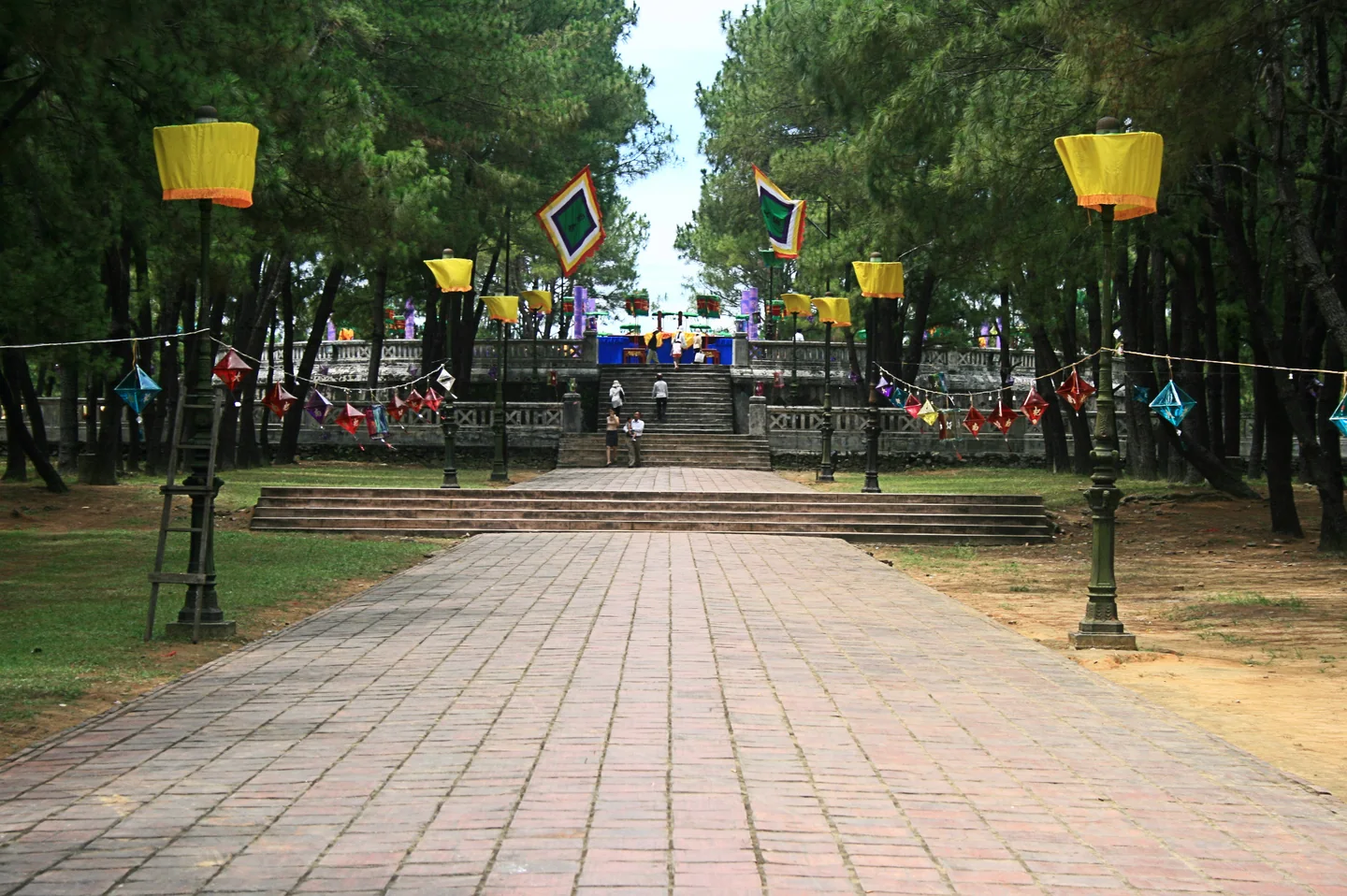
The approach and trees at Nam Giao Esplanade, Hue.
Lưu Ly at vi.wikipedia · Public domain · Resized and converted to WebP

A new dynasty’s ceremonial landscape
Construction of the surviving esplanade began under Emperor Gia Long in 1806, with the first ceremony here in 1807. These dates place it in the early Nguyen dynasty, not in the earlier history of the Nguyen lords. The setting was used for the court’s rites of Heaven and Earth; it was not a royal tomb or an everyday residential palace. Keep that function in mind when the open ground seems less immediately elaborate than other monuments. The important architecture includes platforms, boundaries and routes, as well as anything that rises above them.
Find the circle within the squares
Three stacked terraces organise the central composition. The upper circular terrace represents Heaven, while the square terrace below expresses Earth; the lowest level completes the three-part relationship with humanity. Read these as historical ideas embodied in a designed place, rather than present-day scientific descriptions. Looking from a position where the levels can be distinguished makes the symbolism easier to grasp. Ask a guide to explain how temporary ceremonial arrangements once activated the permanent layout: today’s open surfaces are not the same as the site prepared for an imperial rite.
Choose explanation over a promised reenactment
Nam Giao suits visitors curious about how political authority and cosmology shaped architecture. It can complement a palace visit precisely because it offers a different function and scale. Request a current visitor route and confirmation of access for your date; a historical description does not establish which levels you may enter. Do not assume that a ceremony or reenactment accompanies an ordinary visit, or copy an old festival announcement into your plans. A simple plan or a guide’s explanation can be more valuable than waiting for a performance: the reward is learning to read the landscape itself as an instrument of ritual.
Ask VietnamGuide AI
Ask VietnamGuide AISources
- 1. vietnamtourism.vn/index.php/tourism/items/452/5
Source checked:
Explore more
- Perfume River: choose your kind of boat experience
See Hue from the Perfume River and understand the difference between sightseeing, Ca Hue listening and dining afloat.
- Truong Tien Bridge: see Hue from both riverbanks
Read the steel curves and layered history of Truong Tien Bridge, then choose a riverfront walk that reveals Hue from different angles.
- Dong Ba Market: understand Hue through everyday trade
Explore Dong Ba's food, clothing and gift trade on the north bank of the Perfume River, with thoughtful choices for a market visit.