Travel guide
Hue beyond the throne: Dien Tho and Tu Hieu
Look beyond emperors’ biographies through two different traces: a queen-mother residence and remembrance of court workers. Neither place tells the whole story of the people associated with it.
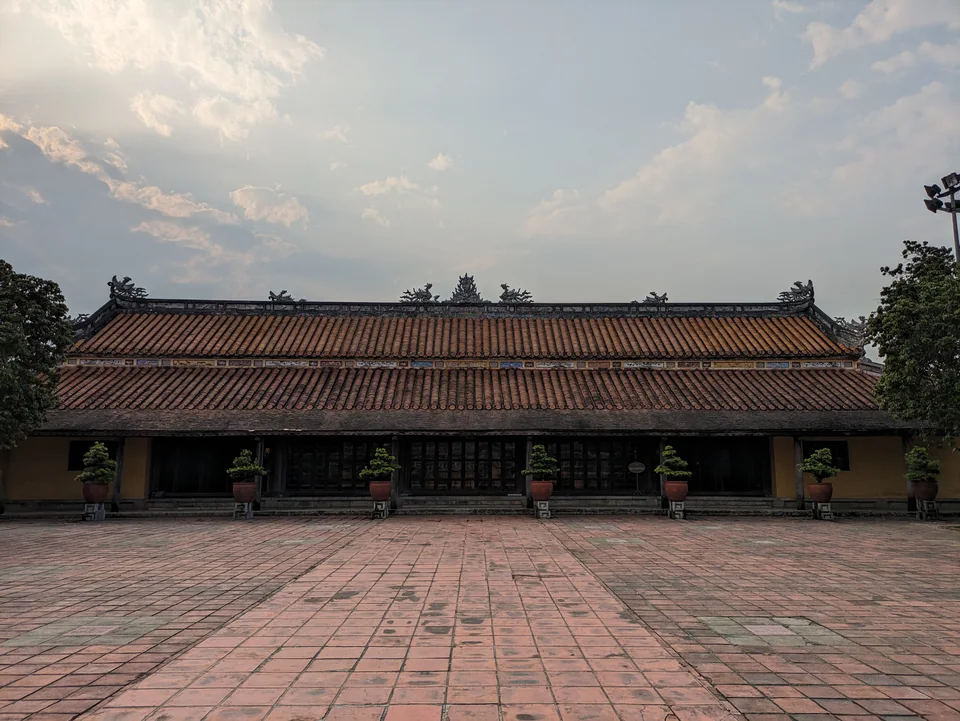

Dien Tho and Truong Sanh: another side of royal life
Dien Tho developed as a residence for queen mothers, with construction beginning in 1803. Its buildings were added to and adapted through different reigns, so the ensemble should not be read as one untouched design from one moment. A recent Vietnam News Agency photo report highlights its variety of halls, pavilions and other structures. Look at the relationship between a principal building and the courtyards and smaller spaces around it. This is a useful change of scale after Thai Hoa: royal status expressed through an inhabited precinct rather than a court assembled before the throne.
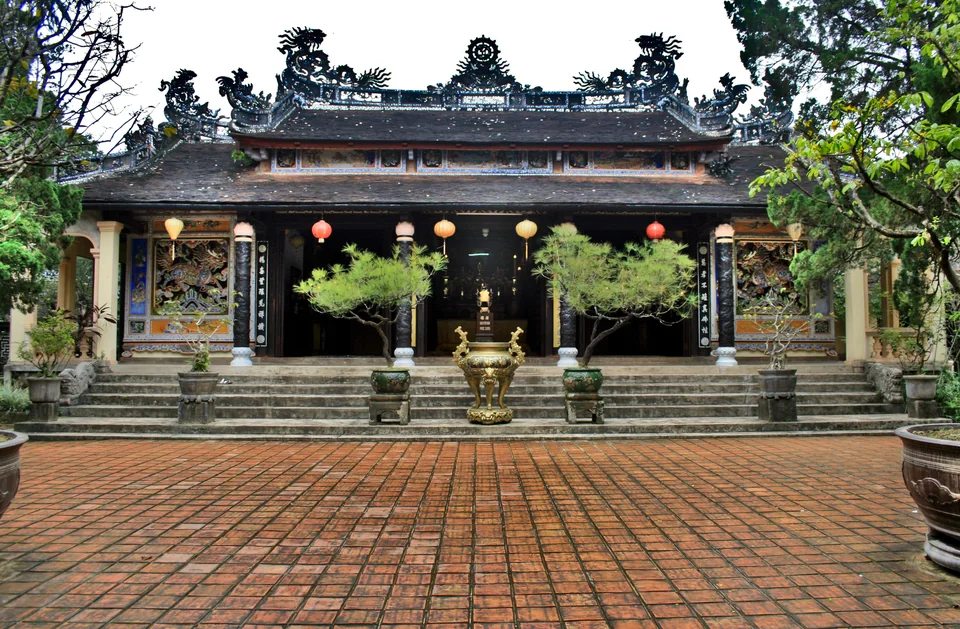

Tu Hieu Pagoda: a contemplative landscape and royal connections
The approach through pine trees and the semicircular pond make water and vegetation part of the architectural experience. Notice how the entrance frames the buildings, then how courtyards lead towards worship and remembrance. Tu Hieu is also associated with court eunuchs who supported the temple; their burial ground recalls people whose lives are often absent from accounts centred on emperors. Treat that connection as social history rather than a curiosity. Together, the founder’s story and the graves broaden the meaning of royal Hue beyond ceremonial power and monumental tombs.
A comparison notebook for your visit
| Choice | What to consider |
|---|---|
| Dien Tho | Dien Tho: note whom the residential space served and how courts and halls organised life, rather than recording only the reigning builder. |
| Tu Hieu | Tu Hieu: ask how patronage relates to the burial ground; separate sourced social history from what a facade photograph establishes. |
| Afterwards | Afterwards: compare one living need with one form of remembrance. Architecture does not reveal everyone’s character or complete life. |
Ask VietnamGuide AI
Ask VietnamGuide AISources
- 1. khamphahue.com.vn/Du-lich/Ban-%C4%91o-so/WC-cong-cong/pid/1584/cid/28
Source checked:
- 2. khamphahue.com.vn/desktopmodules/DNNTinBai/PrintTinBai.aspx
Source checked:
- 3. www.vietnamplus.vn/cung-dien-tho-noi-tap-hop-dien-hinh-cac-phong-cach-kien-truc-thoi-nguyen-post1109974.amp
Source checked:
- 4. dsvh.gov.vn/di-tich-lich-su-va-kien-truc-nghe-thuat-quan-the-kien-truc-co-do-hue-2944
Source checked:
- 5. plumvillage.org/articles/celebrating-the-life-of-master-nhat-dinh
Source checked:
- 6. khamphahue.com.vn/Hue-24h/Chi-tiet/tid/Tu-Hieu-co-tu-Hue-Ngoi-chua-an-nhien-mac-tram-voi-thoi-gian.html/pid/10754/cid/165
Source checked:
Explore more
- Bridge or gate: two kinds of passage in Hue
A village bridge and an imperial gateway both cross a boundary, but serve different purposes. Read function at Thanh Toan and Ngo Mon before looking for a photograph.
- Museum objects and the Nine Urns: two kinds of historical evidence
An exhibited object and a scene cast in bronze can both evoke life, yet provide different evidence. Try a two-column notebook while exploring Hue.
- Dong Khanh and Thien Mu: one monument name, several building periods
Do not attach every visible structure to a single foundation date. These Hue sites help separate the history of a place from the age of its individual parts.