Travel guide
Thuy Xuan incense village: look beyond the colour
The fans of bright incense sticks make Thuy Xuan immediately recognisable, but the craft is more interesting than a photographic backdrop. Behind the colour are bamboo, aromatic ingredients, skilled hands and an object used in remembrance and worship. Visit with a question about making, not just a picture in mind.
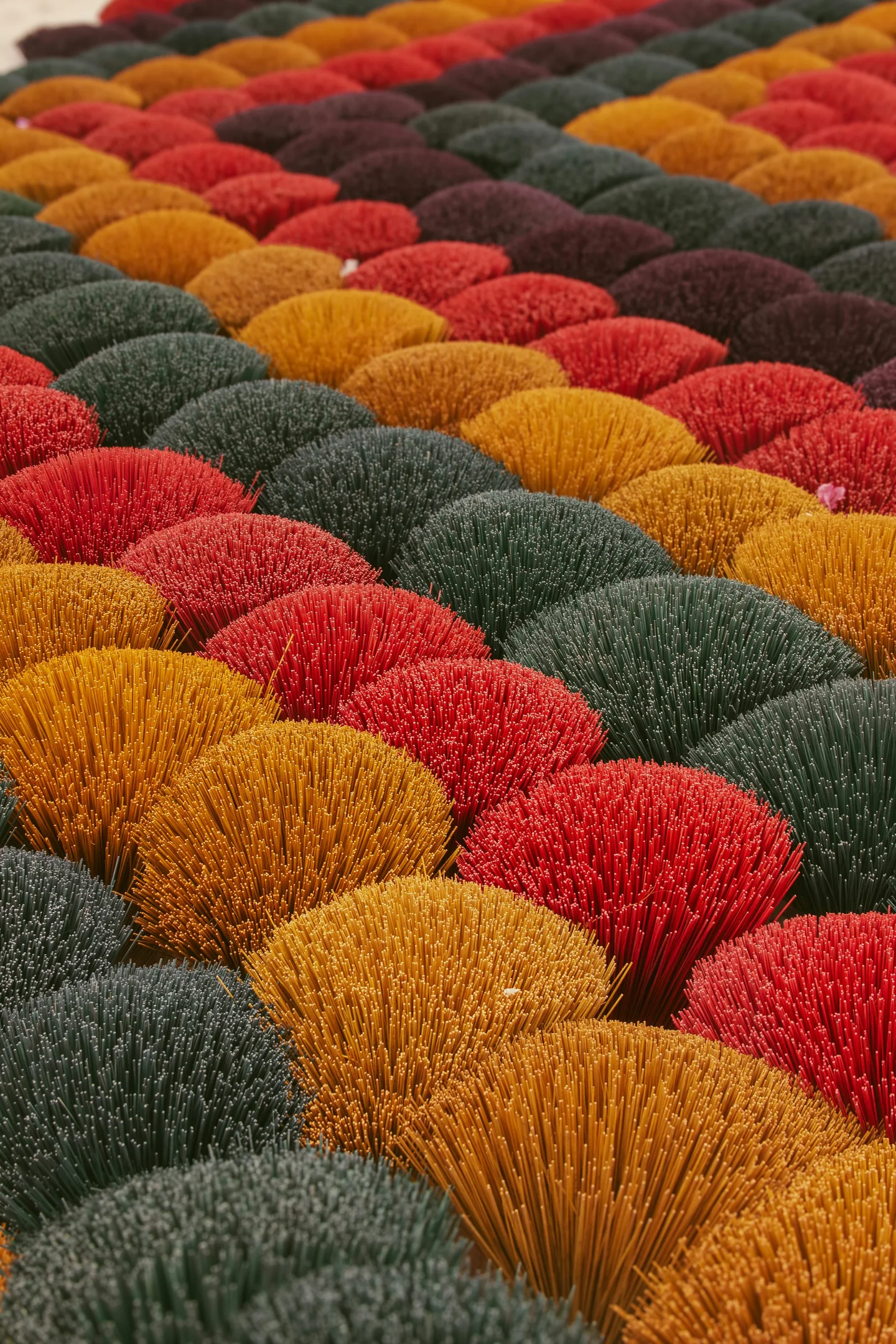
Reference photo: Coloured incense bundles in Hue; a craft illustration, not a verified workshop in Thuy Xuan.
monica dahiya · Unsplash License · Resized and converted to WebP
Separate the colourful core from the incense body
Thuy Xuan's craft-and-shop area is associated with Huyen Tran Cong Chua street, on the route towards Tu Duc's tomb and Vong Canh. The flower-like displays often show bundles of brightly coloured stick bases. Look beyond that arrangement to the distinction between the narrow bamboo core and the aromatic coating. Traditional accounts describe bamboo being split into thin cores and dried before a workable incense paste is rolled around it. An even layer needs practised control. Watching that relationship between core, paste and hand movement gives the finished stick more meaning than its colour alone.
Ask what creates the fragrance
Published accounts of local production describe aromatic ingredients such as cinnamon, clove and star anise, as well as different incense products. Treat these as examples of a craft with variations, not a recipe shared by every maker. Ask which ingredients and processes belong to the item being shown. If a craftsperson offers a demonstration, notice how the coating is shaped and then set out to dry. Trying a step can help explain the skill, but participation needs agreement with that workshop. A display does not prove that every stick was handmade there, and an attractive scent is not evidence for product-quality or health claims.
Make room for the people and the purpose
Incense belongs to household and religious practices, including remembering ancestors; that use adds context to a street often photographed for its colours. Ask permission before arranging yourself among displays, moving bundles or photographing a worker closely, and clarify any charge for a photo setup or activity. If buying, choose the actual product by fragrance, format, maker information and packaging suited to your journey. A short craft stop can accompany a separately planned tomb or landscape visit, but leave time for conversation instead of using the shop only as a backdrop. Confirm current workshop arrangements directly; historical reports of visitor participation are not a standing timetable.
Ask VietnamGuide AI
Ask VietnamGuide AISources
- 1. khamphahue.com.vn/desktopmodules/DNNTinBai/PrintTinBai.aspx
Source checked:
- 2. khamphahue.com.vn/desktopmodules/DNNTinBai/PrintTinBai.aspx
Source checked:
Explore more
- Perfume River: choose your kind of boat experience
See Hue from the Perfume River and understand the difference between sightseeing, Ca Hue listening and dining afloat.
- Truong Tien Bridge: see Hue from both riverbanks
Read the steel curves and layered history of Truong Tien Bridge, then choose a riverfront walk that reveals Hue from different angles.
- Dong Ba Market: understand Hue through everyday trade
Explore Dong Ba's food, clothing and gift trade on the north bank of the Perfume River, with thoughtful choices for a market visit.