Travel guide
Tay An Pagoda: architecture, worship and a thoughtful visit
Tay An is a good choice if you want to look closely at a Buddhist pagoda rather than collect another viewpoint. Start with its exterior, enter only the areas open to visitors, and leave time for worshippers. It belongs to the Sam Mountain foothill cluster, not the summit route.
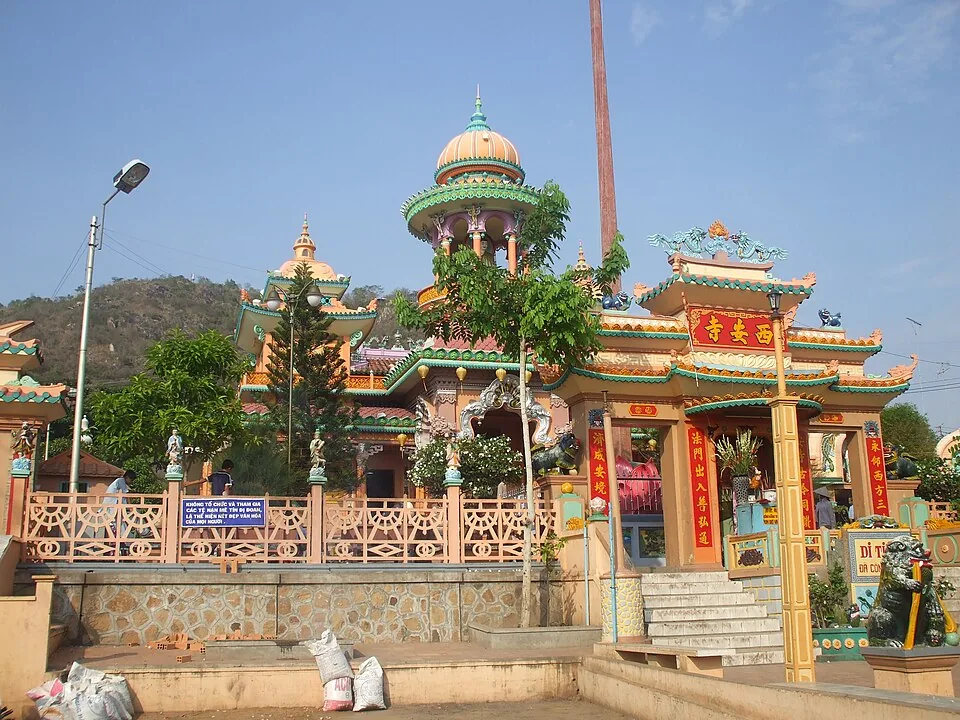
Exterior of Chùa Tây An at the foot of Núi Sam — Archive photograph; it does not establish current access or operating conditions. ·
Thuydaonguyen / Wikimedia Commons; CC BY-SA 3.0; resized and converted to WebP · CC BY-SA 3.0 · Resized and converted to WebP

Locate the pagoda before choosing a route
Save the pin for Chùa Tây An, not simply Núi Sam. The current administrative address is in Vĩnh Tế ward; older travel pages may still show the former Núi Sam ward or Châu Đốc city. Confirm the entrance and pickup location with your driver. A booking described only as a Sam Mountain excursion does not tell you whether this pagoda is included, or whether the vehicle stops close to the entrance.
Read the exterior before entering
The provincial tourism dossier describes a combination of Vietnamese and Indian-influenced architectural features. Look at the relationship between the central worship hall, decorative towers, curved rooflines and colour before trying to label every detail. An architectural influence does not change the pagoda into a mosque or prove that every visible element dates to the same period. A slow exterior observation is worthwhile even if a service makes an interior visit inappropriate.
Keep history and tradition distinct
Official historical material gives 1847 as the founding year and records subsequent renovation. That does not make all of today's fabric original to 1847. If a guide tells the story of the founder's vision or another miraculous event, understand it as a transmitted religious tradition unless separate historical evidence is given. Ask what a feature represents and when it was added; those questions are more useful than repeating an unsupported claim that the building is the first or the largest of its kind.
Let worship set the pace
Wear clothing appropriate for a religious site, speak quietly and follow the posted instructions about footwear and photography. Pause before a threshold rather than stepping into a prayer or blocking someone making an offering. Ask before photographing a monk, a worshipper or an interior altar. A welcoming courtyard is not blanket permission to enter residential or service areas. Donation and worship are personal choices; an architectural visit does not require purchasing a ritual package.
Choose a focused neighbouring stop
If everyone is comfortable continuing, combine Tay An with one nearby foothill monument, such as Miếu Bà Chúa Xứ or the tomb of Thoại Ngọc Hầu. Treat them as different places: a goddess shrine, a Buddhist pagoda and a memorial have different meanings. Chùa Hang involves a separate stepped approach, so it is not an automatic add-on for a group seeking minimal walking. Keep a meal or rest interval instead of adding every site around the mountain.
Check practical conditions on the day
Ask the pagoda or local host about visitor access if an observance is under way; do not rely on an old opening-hours table. Travellers with mobility needs should confirm the actual drop-off, steps and resting places rather than infer step-free access from the foothill location. In rain, allow for wet approaches and footwear changes. If the group is tired, finish with the exterior and one meaningful observation instead of rushing through a crowded hall.
Ask VietnamGuide AI
Ask VietnamGuide AISources
Explore more
- Chua Hang in Chau Doc: decide whether the stepped visit suits you
Plan a visit to Chua Hang, also called Phuoc Dien Pagoda, around its stepped approach. Compare a full visit with a lower-effort alternative without assuming accessible facilities.
- Chau Doc in rain or strong heat: choose a useful Plan B
Decide when to shorten a Chau Doc visit, move a mountain or boat outing, or postpone travel; covered areas alone do not make an attraction weatherproof.