Travel guide
Gia Long and the Nine Urns: what carries dynastic memory?
A tomb brings hills into its composition; bronze vessels gather images of a country. Shift your viewing scale to see different ways a dynasty is remembered.
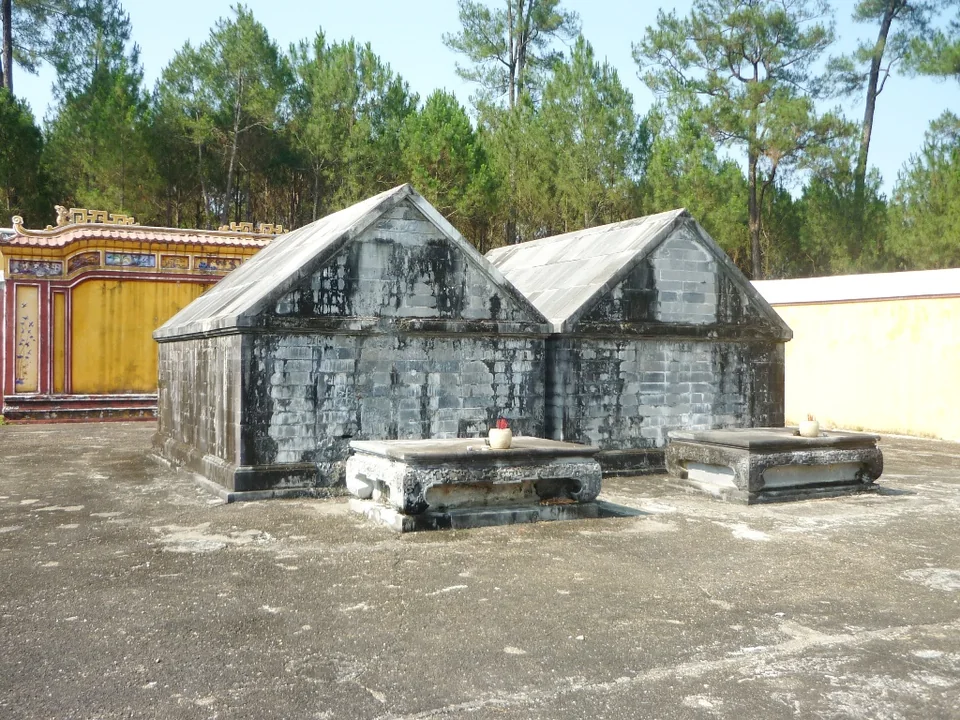

Gia Long Tomb: understand the Thien Tho landscape
The main mausoleum developed between 1814 and 1820, following the death of Empress Thua Thien. Dai Thien Tho hill provides the principal foreground feature, with surrounding hills contributing to the planned setting. Look at the profile beyond the courts before concentrating on masonry: this is a design in which the terrain carries much of the effect. The contrast between a relatively restrained built form and the larger landscape is worth observing in its own right, without needing to describe the place as empty, undiscovered or always peaceful.
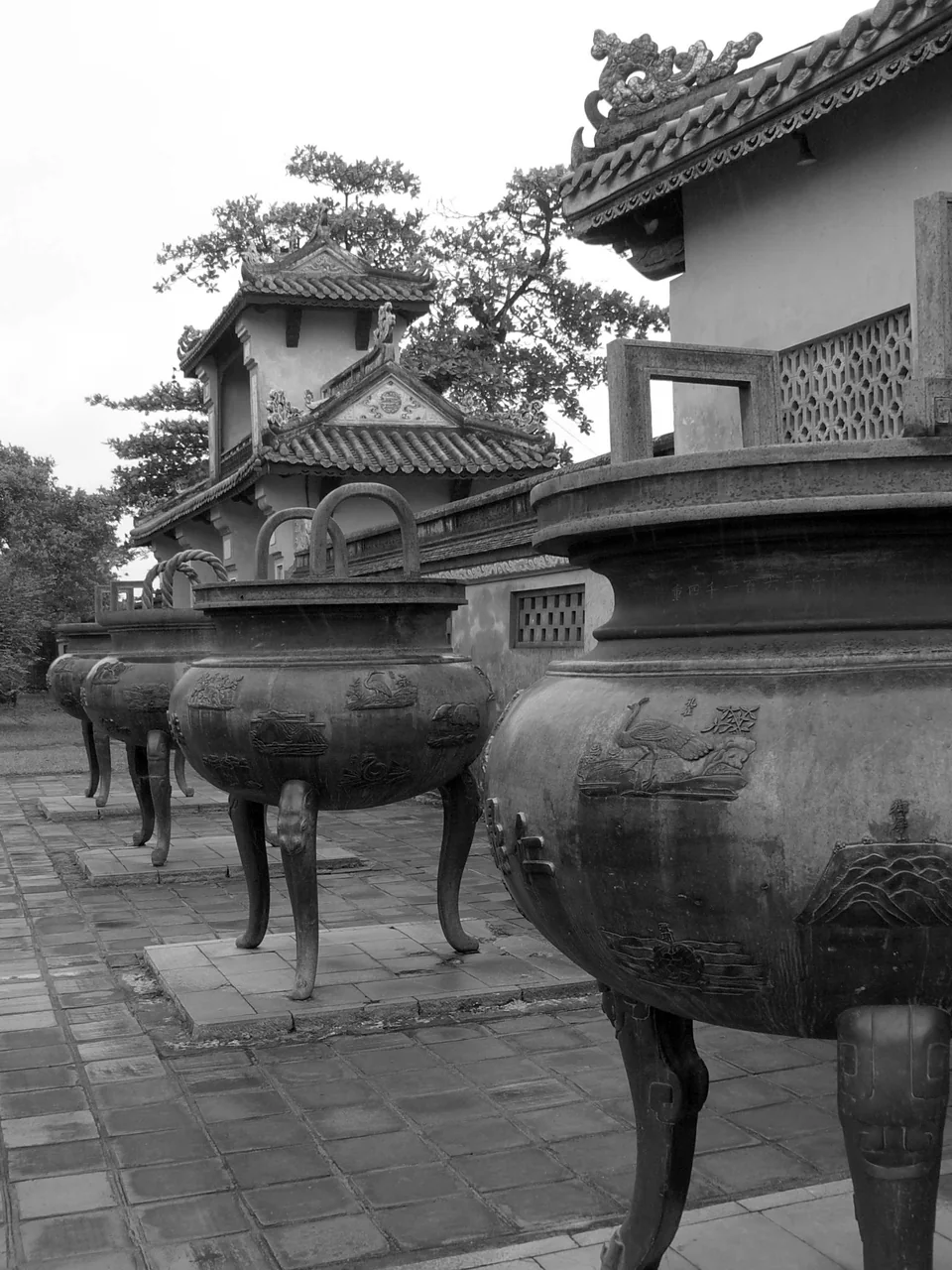

The Mieu and the Nine Dynastic Urns: Nguyen memory in bronze
Cast under Minh Mang in the 1830s, the urns are not nine identical containers. Their handles, supports and relief designs invite comparison. The imagery ranges across mountains, rivers, plants, animals, boats and weapons, bringing a view of the country into the court. Pick two or three subjects to compare rather than trying to identify everything at once. A rice plant or a sailing vessel can make the decoration easier to approach than an unfamiliar imperial title. Look at the relationship between image and inscription, and use a guide or explanatory panel to distinguish a named place from a symbolic creature.
A comparison notebook for your visit
| Choice | What to consider |
|---|---|
| At the tomb | At the tomb: sketch one relationship between court, building and hill. Record observation before asking for a sourced design interpretation. |
| At the Urns | At the Urns: choose motifs from two categories, such as plants and boats. Check names instead of assigning symbolism yourself. |
| Compare | Compare: landscape creates distance and direction; relief gathers many images on one surface. This reading does not establish that both places were designed as a set. |
Ask VietnamGuide AI
Ask VietnamGuide AISources
- 1. huetourism.gov.vn/lang-vua-gia-long-thien-tho-lang-uy-nghiem/
Source checked:
- 2. vietnam.travel/things-to-do/an-inside-guide-hue-tombs
Source checked:
- 3. khamphahue.com.vn/Du-lich/Ban-%C4%91o-so/WC-cong-cong/pid/1584/cid/28
Source checked:
- 4. artsandculture.google.com/story/the-nine-dynastic-urns-quang-binh-tourism-department/vAUh_i4YibICLw
Source checked:
- 5. www.unesco.org/en/articles/unescos-memory-world-mow-regional-register-inscribes-20-new-items-recognition-human-innovation-and
Source checked:
- 6. whc.unesco.org/en/list/678/
Source checked:
Explore more
- Hue beyond the throne: Dien Tho and Tu Hieu
Look beyond emperors’ biographies through two different traces: a queen-mother residence and remembrance of court workers. Neither place tells the whole story of the people associated with it.
- Bridge or gate: two kinds of passage in Hue
A village bridge and an imperial gateway both cross a boundary, but serve different purposes. Read function at Thanh Toan and Ngo Mon before looking for a photograph.
- Museum objects and the Nine Urns: two kinds of historical evidence
An exhibited object and a scene cast in bronze can both evoke life, yet provide different evidence. Try a two-column notebook while exploring Hue.