Travel guide
Two waterscapes in Hue: river bridge and tomb lake
Similar water colours can play different roles in movement and architectural viewing. Read Truong Tien and Minh Mang’s landscape through their lines.
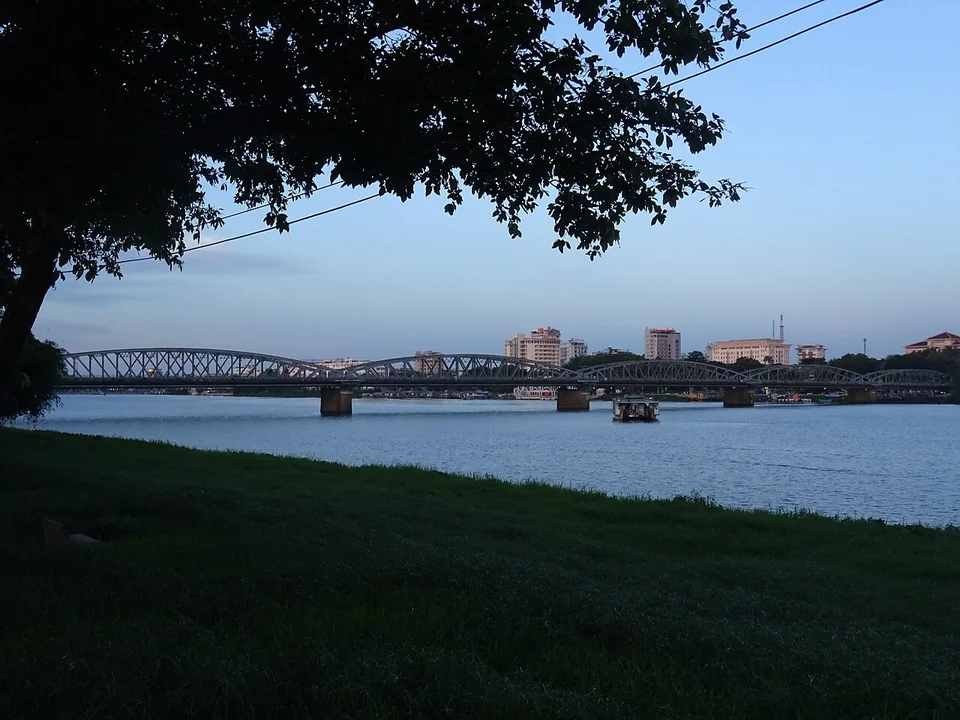

Truong Tien Bridge: see Hue from both riverbanks
From a riverside viewpoint, look for the sequence of six curved steel spans. Their repetition is easier to appreciate from the bank than from within the structure, where the view breaks into close-up beams, railings and moving traffic. Shift your position along the waterfront and watch the spans overlap or separate against the opposite shore. Include a little water and riverbank in a photograph to explain the bridge's setting. This is an urban river crossing, so its interest lies partly in the movement of the city around it, rather than in an isolated architectural portrait.
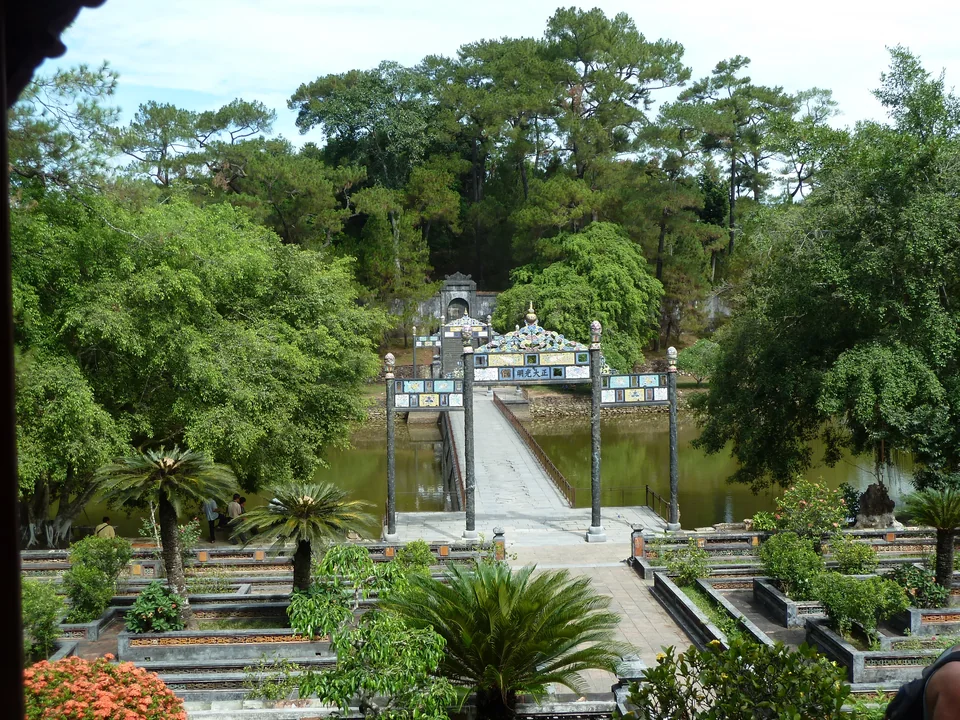

Minh Mang Tomb: architecture between lakes and hills
Trung Minh Lake and its bridges lead the composition towards Minh Lau, the square, two-storey pavilion on Tam Tai hill. Farther along, crescent-shaped Tan Nguyet Lake curves around the burial enclosure. Straight architectural lines and curved water edges give the place two different visual rhythms. Try looking at the pavilion as part of the hill and lake before isolating its roof in a photograph. A pause at this transition can reveal more about the design than moving straight from one named building to the next without looking back.
A comparison notebook for your visit
| Choice | What to consider |
|---|---|
| By the river | By the river: sketch bridge rhythm and the view from the bank. A permitted public viewpoint does not authorise access to every water edge. |
| At the tomb | At the tomb: trace how lake, bridge and buildings lead the eye; separate sourced design description from your own observation. |
| Compare | Compare: water alongside urban movement and water within a tomb landscape. Do not infer a boat route or hydrological link between them. |
Ask VietnamGuide AI
Ask VietnamGuide AISources
- 1. visithue.vn/Nhung-dieu-it-nguoi-biet-ve-cay-cau-huyen-thoai-xu-Hue.html/
Source checked:
- 2. khamphahue.com.vn/desktopmodules/DNNTinBai/PrintTinBai.aspx
Source checked:
- 3. vietnam.travel/places-to-go/north-central-coast/hue
Source checked:
- 4. huetourism.gov.vn/Net-kien-truc-lam-me-hoac-long-nguoi-cua-lang-Minh-Mang.html/
Source checked:
- 5. vietnam.travel/things-to-do/an-inside-guide-hue-tombs
Source checked:
- 6. whc.unesco.org/en/activities/318/
Source checked:
Explore more
- Hue beyond the throne: Dien Tho and Tu Hieu
Look beyond emperors’ biographies through two different traces: a queen-mother residence and remembrance of court workers. Neither place tells the whole story of the people associated with it.
- Bridge or gate: two kinds of passage in Hue
A village bridge and an imperial gateway both cross a boundary, but serve different purposes. Read function at Thanh Toan and Ngo Mon before looking for a photograph.
- Museum objects and the Nine Urns: two kinds of historical evidence
An exhibited object and a scene cast in bronze can both evoke life, yet provide different evidence. Try a two-column notebook while exploring Hue.