Travel guide
Fujian Assembly Hall: understand Hội An’s community heritage
Fujian Assembly Hall, also written Phúc Kiến or Fukian, is more than an ornate entrance on Trần Phú Street. It helps explain how people from the same home region built community in Hội An’s trading-port society. Choose it if you want to understand shared worship and gathering spaces, rather than simply collect photographs of colourful gates.
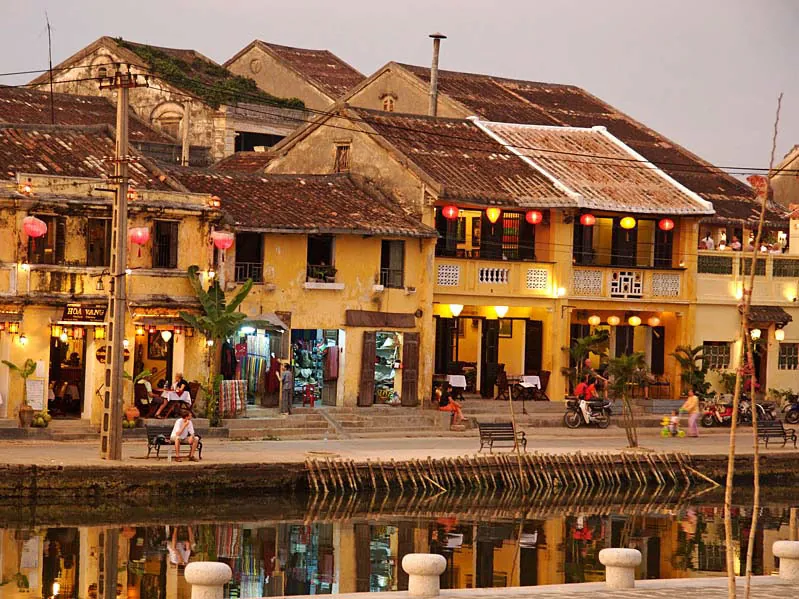
Illustration of Hoi An’s historic town setting; not the featured building or a museum interior. ·
Jean-Marie Hullot · CC BY-SA 3.0 · Resized and converted to WebP

Follow the sequence of spaces
The local heritage authority describes a gate, courtyard, vestibule and worship spaces leading towards the main hall. Notice how the experience changes from an outward-facing entrance to areas intended for gathering and devotion. Look back from an allowed position to understand how the spaces connect; do not treat every doorway as permission to enter.
An assembly hall served community activities for people sharing regional origins. This function makes the visit different from a merchant-house interior: the useful question is how a community met and maintained connections, not how one family arranged its home.
Look for the sea-travel connection
The authority identifies Thiên Hậu Thánh Mẫu at the central altar of the main hall. It also describes a model sailing vessel, including spaces representing life aboard. Together these features provide a way to discuss sea travel and religious protection within the trading-port setting. Beliefs should be described as beliefs, not as promises of protection.
Observe quietly where worship is taking place. Keep clear of offerings, avoid touching objects and ask before photographing people. Follow current signs concerning interiors, footwear or photography; this guide does not establish permission to enter every room.
Choose depth over a rushed collection
If your time is limited, allow this one hall a considered visit rather than hurrying through several similar entrances. Ask a guide to explain the community function and the objects you can actually see. Avoid assigning a meaning to every motif without supporting interpretation.
Confirm current hours, tickets and temporary restrictions through official visitor information. If step-free access matters, ask about the complete route rather than only the front gate. Link this focused stop to the existing two-day Hội An itinerary; no tour booking, fare or opening arrangement is guaranteed here.
Ask VietnamGuide AI
Ask VietnamGuide AISources
Explore more
- Duc An house: reading Hoi An’s history of books and political networks
Understand Duc An house through books, anti-colonial networks and its preserved domestic architecture, without assuming current visitor services.
- Tran family chapel: ancestry and thresholds in Hoi An
Understand the Tran family chapel at 21 Le Loi through ancestral worship, domestic space and the meaning of its threshold, with respectful visitor planning.
- Cam Pho communal house: village life beneath Hoi An’s trading history
Read Cam Pho communal house through its village function, ceremonial architecture and archaeological evidence, with careful visit planning.