Travel guide
Cam Pho communal house: village life beneath Hoi An’s trading history
Cam Pho communal house at 52 Nguyen Thi Minh Khai helps explain a part of Hoi An that a merchant-house visit alone cannot: the organisation of a village community. Trade did not replace local worship, administration or collective memory. The communal house makes those functions visible through a shared ceremonial setting, making it especially relevant to visitors interested in how the town’s communities worked rather than only in individual wealthy households.
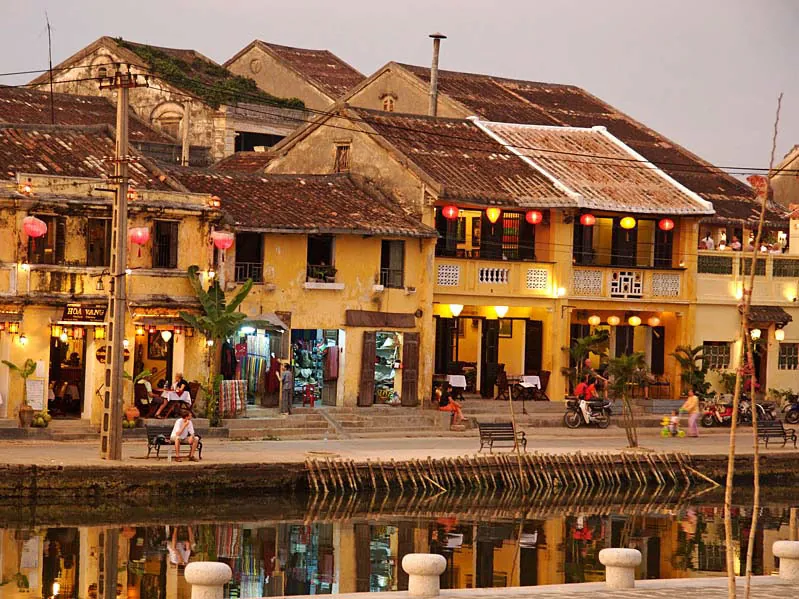
Illustration of Hoi An’s historic town setting; not the featured building or a museum interior. ·
Jean-Marie Hullot · CC BY-SA 3.0 · Resized and converted to WebP

Understand the communal purpose
The heritage authority describes the site as a place for the village guardian deity, water-related deities and people honoured for their contribution to the village. It also explains the former administrative and communal cultural roles. A communal house is therefore not simply another family chapel, assembly hall or Buddhist temple.
The name Cam Pho Huong Hien connects the building with the memory of village predecessors. Ask how worship and collective business occupied the same institution. Published heritage pages differ over the precise year of an early nineteenth-century restoration, so this guide does not present one disputed restoration year as settled fact.
Look at a sequence of shared spaces
The official architectural account describes an entrance gateway, courtyard, front ceremonial structure, main hall and eastern and western buildings. Follow the relationship between these spaces instead of looking only for a single striking facade. The front structure is described with four roof slopes and carved lantern forms at the beam ends.
The main hall’s bays and the side buildings help distinguish the layout from a narrow merchant home. The source also discusses the work of Kim Bong artisans. Ask which carvings or construction details an explanation specifically identifies; do not assume every decoration visible today has an identical date, maker or meaning.
Connect archaeology and a present-day visit
The authority reports archaeological investigation in the courtyard, including a 1994 trench with ceramics from Japan, China and Vietnam dated to the sixteenth and seventeenth centuries. This is evidence for occupation and exchanges in the area, not proof that every standing wall is from that period. Observe without touching archaeological material or entering restricted ground.
Confirm current entry, ticket coverage, photography and any ceremony before arranging your walk. A description of historical seasonal festivals does not guarantee an event during your stay. Keep worship space clear and ask about steps or uneven surfaces if mobility is a concern. A short visit with a clear question about community life can be more rewarding than treating the courtyard only as a photograph stop.
Ask VietnamGuide AI
Ask VietnamGuide AISources
Explore more
- Duc An house: reading Hoi An’s history of books and political networks
Understand Duc An house through books, anti-colonial networks and its preserved domestic architecture, without assuming current visitor services.
- Tran family chapel: ancestry and thresholds in Hoi An
Understand the Tran family chapel at 21 Le Loi through ancestral worship, domestic space and the meaning of its threshold, with respectful visitor planning.
- Quan Cong temple: trust, worship and inscriptions in Hoi An
Explore Quan Cong temple at 24 Tran Phu through its merchant-community meaning, timber architecture and restoration inscriptions, with respectful visit planning.