Travel guide
Quan Cong temple: trust, worship and inscriptions in Hoi An
Quan Cong temple at 24 Tran Phu, also known as Chua Ong or Trung Han Cung, is a distinct stop for understanding the relationship between worship and commercial trust in old Hoi An. Its story is not interchangeable with a family chapel or the nearby market. The heritage conservation centre connects Quan Cong’s symbolism of loyalty and trustworthiness with the trading community, making the temple useful for visitors interested in belief as part of everyday economic life.
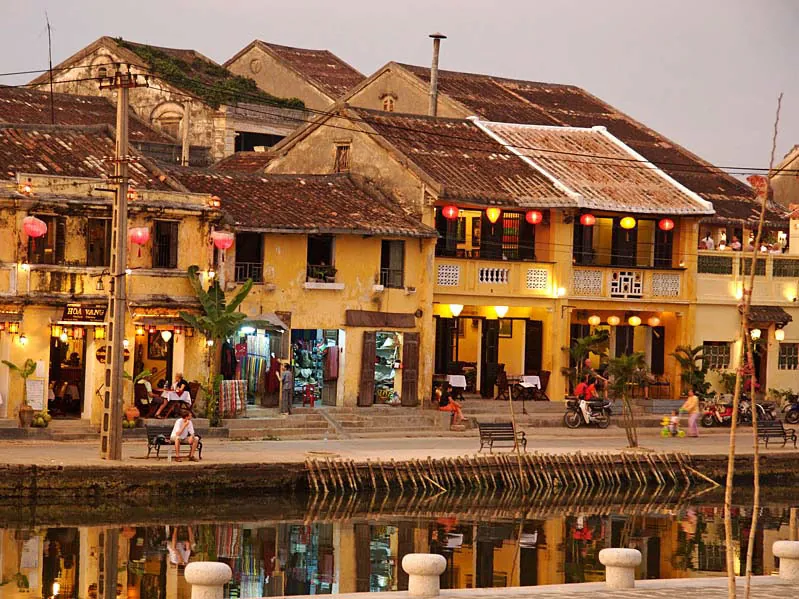
Illustration of Hoi An’s historic town setting; not the featured building or a museum interior. ·
Jean-Marie Hullot · CC BY-SA 3.0 · Resized and converted to WebP

Identify whom and what the temple honours
The official heritage description identifies Quan Cong as a figure from China’s Three Kingdoms period. His religious representation carries later meanings; a statue or traditional story should not be treated as a literal historical record of everything its subject did. The visitor’s task is to understand how the community used that image.
The conservation account describes Quan Cong, Quan Binh and Chau Thuong, with the red and white horses, within the temple’s worship ensemble. Read these as a connected sacred setting rather than separate decorative props. Do not rearrange offerings or approach a statue for a close photograph without permission.
Read architecture and restoration together
The documented layout includes a front hall, main sanctuary and two side wings. The conservation source draws attention to substantial timber framing, tiled roofs and ceramic decoration. Look for how the buildings enclose the worship space; this differs from the front-to-back domestic sequence of a merchant house.
A heritage study examines a stone inscription dated 1753 recording restoration. That date is useful evidence of repair and community support, not a label for the age of every visible timber or a precise founding date. Rather than choosing between competing simplified founding claims, ask how inscriptions help historians separate construction, repair and later interpretation.
Plan around living worship
The temple stands opposite the main market in the official description, so it can add a focused religious-history stop to an old-town walk. Market proximity does not make it a shopping venue or a performance space. Keep pathways and altar areas clear, follow local instructions and ask permission before photographing worshippers or sacred objects.
Confirm current access, admission coverage, photography rules and any ceremony directly before visiting. Historical accounts of festivals do not establish a programme on your travel dates. If you cannot read an inscription, seek a sourced explanation rather than inventing a translation from its appearance. A few carefully understood details can be more meaningful than collecting many uncontextualised photographs.
Ask VietnamGuide AI
Ask VietnamGuide AISources
Explore more
- Duc An house: reading Hoi An’s history of books and political networks
Understand Duc An house through books, anti-colonial networks and its preserved domestic architecture, without assuming current visitor services.
- Tran family chapel: ancestry and thresholds in Hoi An
Understand the Tran family chapel at 21 Le Loi through ancestral worship, domestic space and the meaning of its threshold, with respectful visitor planning.
- Cam Pho communal house: village life beneath Hoi An’s trading history
Read Cam Pho communal house through its village function, ceremonial architecture and archaeological evidence, with careful visit planning.