Travel guide
Tran family chapel: ancestry and thresholds in Hoi An
The Tran family chapel at 21 Le Loi is worth considering when your interest is how Hoi An families remember their ancestors. Although often grouped with old houses, its central purpose is different from a merchant shop-house: the house organises remembrance and kinship. That distinction makes it a focused cultural visit, rather than simply another old interior to photograph during an Ancient Town walk.
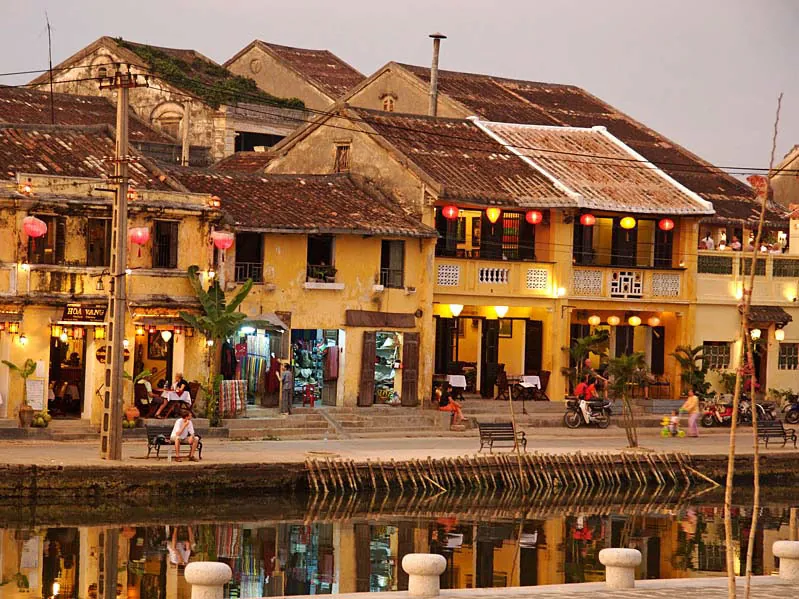
Illustration of Hoi An’s historic town setting; not the featured building or a museum interior. ·
Jean-Marie Hullot · CC BY-SA 3.0 · Resized and converted to WebP

A family history, carefully attributed
The heritage authority’s 2010 account relates the construction to Tran Tu Nhac before an embassy to China at the end of 1802. The account is presented through a descendant’s recollection. Keep that attribution when discussing the founding story, rather than treating a family narrative as an independently dated building survey.
The same source describes the preservation of a sword and seals associated with the ancestor. Such information helps frame a question about what objects mean for a lineage, but it does not guarantee that those objects are on public display today. Ask what is actually being shown and how its connection to the family is explained.
Read the boundary between reception and worship
The official description separates a main worship area from an adjoining part used for the lineage head and guests. It also explains a raised threshold between the reception room and sacred room as a reminder to bow. This is a useful detail to understand before entering: a change in level can carry a ritual meaning as well as a physical obstacle.
The building is described within a walled garden and through East Asian architectural influences. Look for the relationship between an approach, a threshold and the altar rather than reducing the visit to a checklist of national styles. Do not step over barriers, touch ritual objects or enter a garden area merely because it appears in a historical description.
Visit as a guest, not an audience at a show
The authority describes an annual family gathering to honour ancestors. This explains the living social role of the chapel; it is not an invitation to attend a private ceremony or proof of a public event on your travel dates. Give any worshippers space and ask permission before photographs, especially of people and altars.
Before making the chapel a fixed stop, confirm current access, ticket coverage, photography rules and any explanation available in your language. Ask about the threshold and other movement requirements if someone in your group has limited mobility. A respectful visit can remain worthwhile even when some domestic or sacred areas are unavailable.
Ask VietnamGuide AI
Ask VietnamGuide AISources
Explore more
- Duc An house: reading Hoi An’s history of books and political networks
Understand Duc An house through books, anti-colonial networks and its preserved domestic architecture, without assuming current visitor services.
- Cam Pho communal house: village life beneath Hoi An’s trading history
Read Cam Pho communal house through its village function, ceremonial architecture and archaeological evidence, with careful visit planning.
- Quan Cong temple: trust, worship and inscriptions in Hoi An
Explore Quan Cong temple at 24 Tran Phu through its merchant-community meaning, timber architecture and restoration inscriptions, with respectful visit planning.