Travel guide
Ba Mu Temple Gate: understand Hoi An's surviving gateway
Cổng chùa Bà Mụ is often approached as a photograph stop, but the most useful detail is what the name does not tell you: this is a surviving gateway, not a complete historic temple behind an attractive entrance. Understanding that difference lets you appreciate the remnant without expecting rooms and shrines that are no longer there.
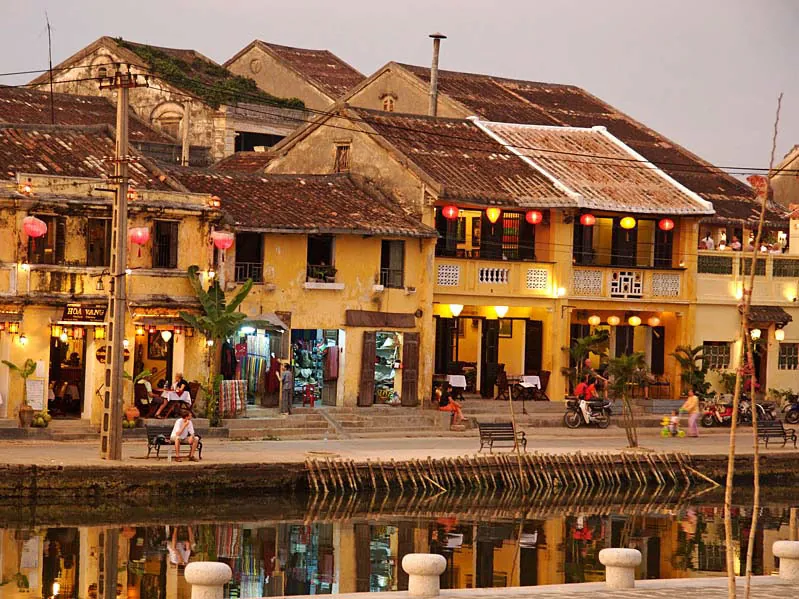
Illustration of Hoi An’s historic town setting; not the featured building or a museum interior. ·
Jean-Marie Hullot · CC BY-SA 3.0 · Resized and converted to WebP

Recognise a gate rather than an intact pagoda
Hoi An's heritage centre describes the remaining gate on Hai Bà Trưng Street and identifies it with the former Cẩm Hà and Hải Bình religious buildings of the Minh Hương community. Its architectural study explains that the popular word chùa does not make the original complex a Buddhist pagoda: the buildings housed a different system of worship. Use the familiar Ba Mu name to locate the gate, but keep the fuller identity when interpreting it. Do not confuse this urban remnant with the separate Ba Mu shrine on Cù Lao Chàm.
Read the surviving form alongside historical evidence
The centre uses old photographs to investigate the lost complex and reports restoration of the entrance. That means the scene before you and the archival image describe different stages of the site. Look at the gate's overall arrangement first, then its openings, curves and decoration; ask which parts an authorised explanation identifies as restored. Avoid imagining that every visible feature is untouched or that you can reconstruct the missing buildings from the gate alone. The research itself recognises limits in the surviving evidence, so an uncertain detail is a reason to ask, not to invent a story.
Make a thoughtful short stop
Give the gateway enough space to be understood rather than waiting only for a person-free photograph. Keep passage clear, follow local directions and do not climb architectural details for a pose. Beliefs associated with Ba Mu should be understood as religious and community traditions, not medical promises or proof that a prayer changes fertility or childbirth outcomes. Confirm current access and any local arrangements before relying on a specific visit plan. This guide does not promise entry to a complete temple, a worship ceremony, an empty photo setting or a fixed opening schedule.
Ask VietnamGuide AI
Ask VietnamGuide AISources
Explore more
- Duc An house: reading Hoi An’s history of books and political networks
Understand Duc An house through books, anti-colonial networks and its preserved domestic architecture, without assuming current visitor services.
- Tran family chapel: ancestry and thresholds in Hoi An
Understand the Tran family chapel at 21 Le Loi through ancestral worship, domestic space and the meaning of its threshold, with respectful visitor planning.
- Cam Pho communal house: village life beneath Hoi An’s trading history
Read Cam Pho communal house through its village function, ceremonial architecture and archaeological evidence, with careful visit planning.