Travel guide
Cantonese Assembly Hall: ceramics and community heritage in Hoi An
Quang Trieu, commonly called the Cantonese Assembly Hall, rewards a visit that looks beyond a colourful gate. Its distinct subject is the heritage of Hoi An’s Cantonese community, not a general checklist of every assembly hall. Use its Vietnamese name when confirming the exact stop with a guide.
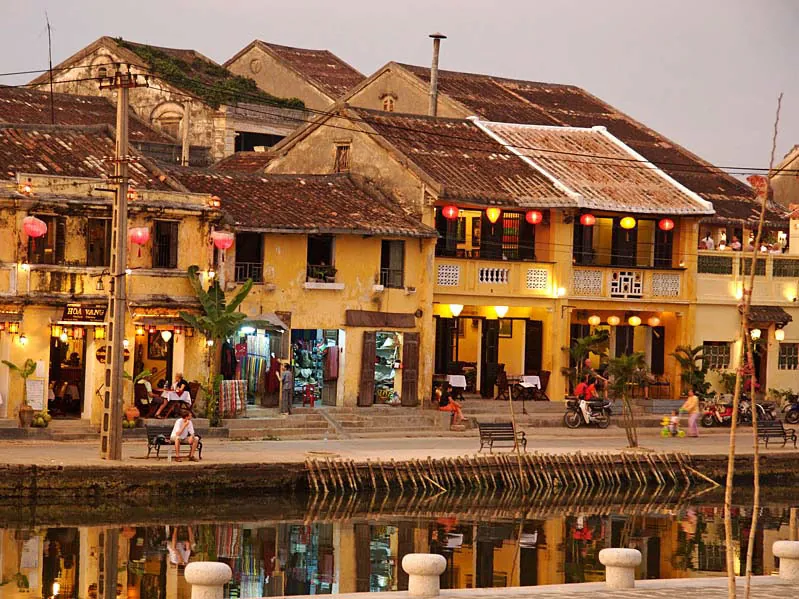
Illustration of Hoi An’s historic town setting; not the featured building or a museum interior. ·
Jean-Marie Hullot · CC BY-SA 3.0 · Resized and converted to WebP

Begin with the ceramic dragon
The local heritage authority identifies a ceramic dragon fountain among the hall’s notable features. Treat that as a starting point for observation: look at how colour and surface texture bring the figure into the courtyard. You do not need to assign a meaning to every fragment. Ask which details are original, repaired or newly interpreted rather than assuming the entire visible surface comes from one period. Photograph from a permitted position and leave room for people passing through.
Read the courtyard as a sequence
A conservation study describes a progression through entrance, forecourt, front hall, middle courtyard and main hall, with buildings to the sides. Follow the spaces that are actually open instead of trying to enter every doorway. Pause where you can see the relationship between roofline and open sky. This is a useful way to compare the building’s spatial organisation with a merchant house without treating a community hall as a domestic home.
Plan one focused heritage stop
For a short visit, choose the dragon and one architectural question rather than rushing through a list of photo targets. Confirm present admission, open areas and any worship taking place directly with the site; an older heritage description is not a current operating notice. Keep voices low near devotional spaces and ask before photographing people or ceremonies. Combine this stop with your existing Old Town walk, allowing a break instead of assuming that all halls offer the same experience. If step-free access matters, ask about the actual route, thresholds and seating before arrival. A photograph of a level courtyard cannot confirm the whole journey through the building. Explain the traveller’s needs clearly and choose a shorter permitted route if the available arrangement does not suit them.
Ask VietnamGuide AI
Ask VietnamGuide AISources
Explore more
- Duc An house: reading Hoi An’s history of books and political networks
Understand Duc An house through books, anti-colonial networks and its preserved domestic architecture, without assuming current visitor services.
- Tran family chapel: ancestry and thresholds in Hoi An
Understand the Tran family chapel at 21 Le Loi through ancestral worship, domestic space and the meaning of its threshold, with respectful visitor planning.
- Cam Pho communal house: village life beneath Hoi An’s trading history
Read Cam Pho communal house through its village function, ceremonial architecture and archaeological evidence, with careful visit planning.