Travel guide
Chaozhou Assembly Hall: carved timber and a maritime community
Chaozhou Assembly Hall, called Trieu Chau in Vietnamese, offers a precise question for a heritage walk: how do craftsmanship and maritime belief share one community building? It is a distinct stop, not another name for Fujian Assembly Hall. Confirm the name when arranging a guide.
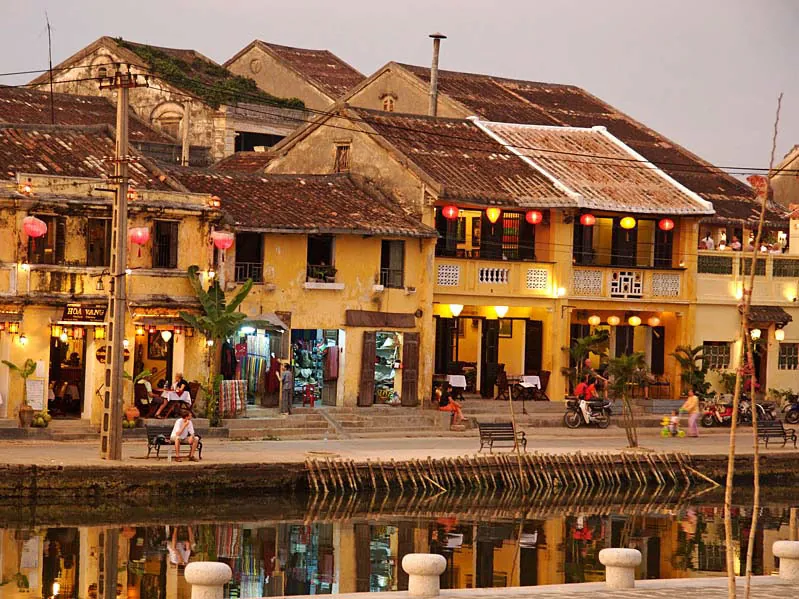
Illustration of Hoi An’s historic town setting; not the featured building or a museum interior. ·
Jean-Marie Hullot · CC BY-SA 3.0 · Resized and converted to WebP

Read the craft before the symbols
The local heritage description highlights carved timber and raised decoration assembled from ceramic pieces. Begin by separating material from meaning: where is the surface wood, and where is it ceramic? Notice how the decoration relates to the supporting frame rather than photographing it as a collection of detached objects. If a figure or scene is unfamiliar, ask for an identified explanation instead of inventing a legend. Do not touch fragile surfaces or use a nearby altar as a support for your camera.
Understand the maritime connection
The hall’s heritage account connects its worship with protection from wind and waves and identifies Phuc Ba in the main hall. Describe this as belief held by a maritime community, not a claim that a deity controls real travel conditions. That distinction helps children and first-time visitors understand the building without confusing devotional language with navigational advice. Ask a guide how the community role and the worship space fit together; it is a better starting point than assuming every assembly hall has the same principal dedication.
Make time for explanation, not repetition
Choose one timber detail and one ceramic detail, then leave time to hear an explanation. If you have already visited another hall, compare what is actually different rather than seeking an identical photo route. Current access, admission arrangements and ceremonies require confirmation with the site. Historical descriptions of gatherings do not guarantee a visitor event today. Keep clear of worshippers, ask permission for photographs of people and accept any closed areas. A visit paired with an unhurried Old Town walk can be useful even without entering every room. For anyone with limited mobility, ask about thresholds and the actual viewing route; an attractive exterior photograph does not establish interior accessibility.
Ask VietnamGuide AI
Ask VietnamGuide AISources
Explore more
- Duc An house: reading Hoi An’s history of books and political networks
Understand Duc An house through books, anti-colonial networks and its preserved domestic architecture, without assuming current visitor services.
- Tran family chapel: ancestry and thresholds in Hoi An
Understand the Tran family chapel at 21 Le Loi through ancestral worship, domestic space and the meaning of its threshold, with respectful visitor planning.
- Cam Pho communal house: village life beneath Hoi An’s trading history
Read Cam Pho communal house through its village function, ceremonial architecture and archaeological evidence, with careful visit planning.