Travel guide
Minh Huong Tuy Tien Duong: community memory beyond a family shrine
Minh Huong Tuy Tien Duong asks a different question from a merchant house: how did a whole community remember the people who established it? The heritage register identifies the hall at 14 Tran Phu. Use the full name when seeking it, since “Minh Huong” also appears in the names of other religious and scholarly sites.
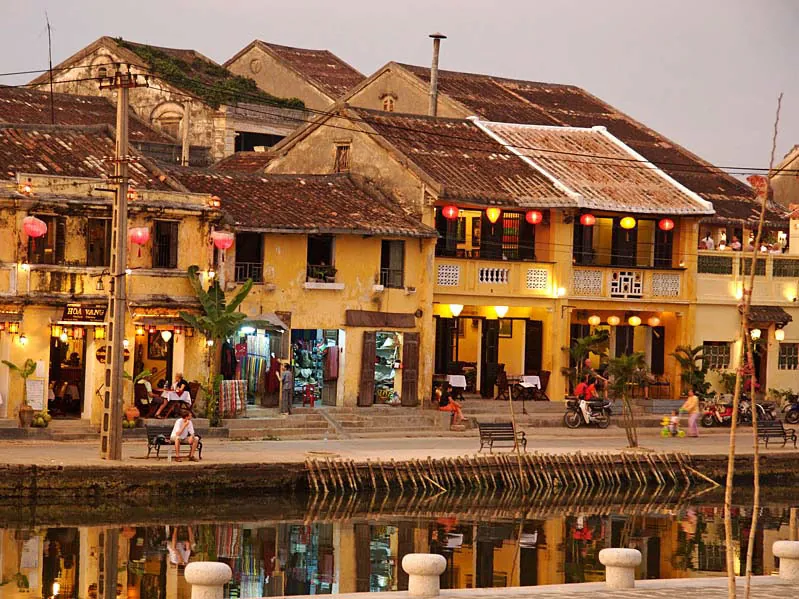
Illustration of Hoi An’s historic town setting; not the featured building or a museum interior. ·
Jean-Marie Hullot · CC BY-SA 3.0 · Resized and converted to WebP

Identify who is remembered here
The heritage authority describes a place honouring the former and later worthies of the Minh Huong community, including groups remembered as Thap Lao, Luc Tanh and Tam Gia. This community focus distinguishes it from a single lineage’s ancestral house. It is also not simply another name for the Five Congregations Assembly Hall.
Commemoration tells you about how people represented shared origins and contributions. Look for the relationship between a collective dedication and individual names, rather than assuming every tablet refers to the same family or deity. Worship and historical record overlap here without being identical kinds of evidence.
Read building history through documentary layers
A heritage study published in 2026 discusses a 1908 stele recalling construction of Tuy Tien Hall in 1820 and relocation in 1905. Read those as events recorded by an inscription, not one date that explains every earlier institution or every surviving piece of timber. Other summaries give different early dates, so an absolute founding-year claim is avoided here.
The register describes a front hall, eastern and western buildings, a rear sanctuary and yin-yang roof tiles. Follow the sequence of open and enclosed space where visitors are permitted. The arrangement helps you understand a communal place of remembrance, rather than judging it only by the largest carved ornament.
Make room for a living community
Ask the custodian which areas can be entered and whether worship or community business affects the visit. Request permission before photographing tablets, interiors or people. Do not move ritual objects, step into restricted spaces or treat the courtyard as a backdrop that must be cleared for your group.
If you want an explanation, ask specifically about the founders, stele and building phases; do not assume a guide or translation is included. Confirm current admission arrangements locally. This guide supplies no opening timetable or fee, and does not guarantee ceremonies for visitors. A short attentive visit can reveal a layer of Hoi An that a generic “old house” checklist misses.
Ask VietnamGuide AI
Ask VietnamGuide AISources
- 1. www.hoianworldheritage.org.vn/vi/news/Diem-di-tich/Tuy-Tien-Duong-Minh-Huong-227.hwh
Source checked:
- 2. hoianheritage.danang.gov.vn/vi/di-san-van-hoa/Dinh/dinh-tuy-tien-duong-minh-huong-so-14-duong-tran-phu-phuong-minh-an-227.html
Source checked:
- 3. hoianheritage.danang.gov.vn/en/specialised-exchanges/research-exchange/events-related-to-historic-monuments-in-hoi-an-in-the-year-of-the-dragon-40.html
Source checked:
Explore more
- Duc An house: reading Hoi An’s history of books and political networks
Understand Duc An house through books, anti-colonial networks and its preserved domestic architecture, without assuming current visitor services.
- Tran family chapel: ancestry and thresholds in Hoi An
Understand the Tran family chapel at 21 Le Loi through ancestral worship, domestic space and the meaning of its threshold, with respectful visitor planning.
- Cam Pho communal house: village life beneath Hoi An’s trading history
Read Cam Pho communal house through its village function, ceremonial architecture and archaeological evidence, with careful visit planning.