Travel guide
Phung Hung old house: trade, timber and family space in Hoi An
Phung Hung house at 4 Nguyen Thi Minh Khai offers a particular way to understand Hoi An: follow the relationship between a trading frontage, a timber building and a family’s sacred space. It is a better choice for visitors interested in how a merchant household worked than for anyone collecting interchangeable yellow-wall photographs. The heritage authority’s historical account supports this interpretation; it does not establish today’s admission arrangements.
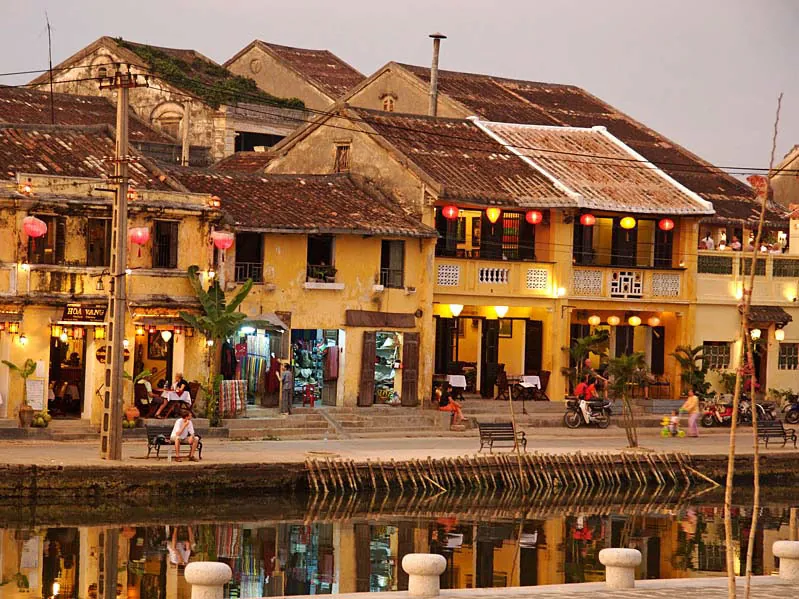
Illustration of Hoi An’s historic town setting; not the featured building or a museum interior. ·
Jean-Marie Hullot · CC BY-SA 3.0 · Resized and converted to WebP

Look for a working merchant house
The official heritage description identifies the building as a tube-shaped trading house with a broad frontage. Its former goods included cinnamon, pepper, salt, silk, porcelain and glass. Think about the different requirements of displaying, receiving and protecting such goods rather than imagining the house as an empty architectural monument.
The name Phung Hung expresses a wish for prosperity. This gives the visit a useful theme: how did the building accommodate trade and domestic life together? Ask which spaces are described as former commercial areas and which still have a family function; do not assume every room is available to visitors.
Read structure before decoration
The conservation account describes timber columns resting on stone bases, removable door panels and a high wooden upper floor. These are useful details to identify before concentrating on ornament. Trace a column upward, then look at the connection between the roof, the frontage and surrounding corridors without leaning on the old wood.
The authority interprets the central four-sided roof, balconies and timber frame through Japanese, Chinese and Vietnamese architectural influences. Treat that as the published interpretation, not proof that every component has one exclusive national origin. Carp-shaped supports add another layer of meaning associated with good fortune and prosperity.
Plan a respectful, focused visit
The historical account places family altars and Thien Hau worship upstairs. Sacred or domestic use takes priority over photographs. Ask about permitted areas, stairs, photography and explanations in a language you understand before entering; a historical description cannot guarantee present access or a guided presentation.
For a compact architecture visit, compare what you can actually see with one or two features above rather than rushing to photograph every corner. Confirm current opening, ticket coverage and any restrictions directly. Keep any comparison with another old house focused on its distinctive function, and leave enough flexibility if a room or upper floor is unavailable.
Ask VietnamGuide AI
Ask VietnamGuide AISources
Explore more
- Duc An house: reading Hoi An’s history of books and political networks
Understand Duc An house through books, anti-colonial networks and its preserved domestic architecture, without assuming current visitor services.
- Tran family chapel: ancestry and thresholds in Hoi An
Understand the Tran family chapel at 21 Le Loi through ancestral worship, domestic space and the meaning of its threshold, with respectful visitor planning.
- Cam Pho communal house: village life beneath Hoi An’s trading history
Read Cam Pho communal house through its village function, ceremonial architecture and archaeological evidence, with careful visit planning.