Travel guide
Hoi An Traditional Art Performance House: listen, watch and ask
Hoi An’s Traditional Art Performance House is a named cultural venue, not a general label for every show in town. The official tourism portal identifies it at 66 Bach Dang, facing the Thu Bon river setting. It suits visitors interested in regional music, movement and theatrical expression within the old-town environment.
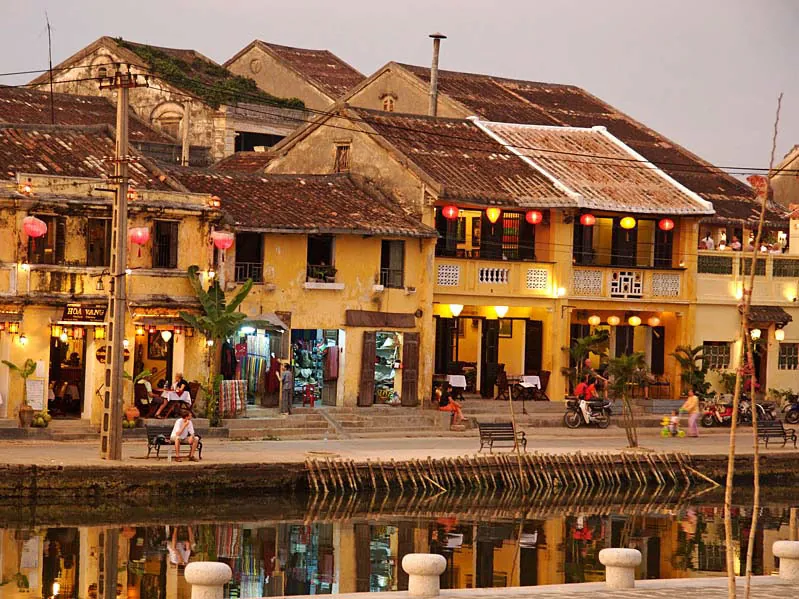
Illustration of Hoi An’s historic town setting; not the featured building or a museum interior. ·
Jean-Marie Hullot · CC BY-SA 3.0 · Resized and converted to WebP

Know the venue before comparing shows
The official account published in November 2025 describes a two-storey setting: masks and traditional instruments on the lower floor, with performance space above. That combination suggests two connected ways to engage—look at an object and then notice how sound, gesture or costume gives it meaning in performance.
The venue is distinct from Hoi An Memories and other separately named productions. A ticket or advertisement for one should not be treated as admission to another. Ask for the exact venue name and entrance rather than booking something described only as “traditional show in Hoi An”.
Listen for regional forms, not a single historical script
The documented repertoire includes Quang Nam and central Vietnamese folk songs, folk dance, traditional instrumental ensembles and Bai Choi singing. A 2026 official spring article also mentions Sac Bua and folk singing here. These accounts demonstrate the cultural range; they do not establish that every form appears in every programme.
You do not need to recognise every lyric to look closely. Notice changes between a solo voice and ensemble, the relationship between movement and rhythm, and how a mask changes the performer’s expression. Ask for a brief explanation of the form instead of assuming each staged item is an unchanged reconstruction of a historical ceremony.
Confirm the actual visit and participation
Before attending, check the current programme, start time, duration and entry conditions directly. The 2025 account describes mask painting and other learning activities, but these should be confirmed individually; a display does not mean you may handle instruments or join a class without an arrangement. Ask about language support if explanation matters to you.
Confirm photography, recording, seating and stair access, particularly for a visitor who needs a step-free route. Silence your phone and follow performers’ or staff directions rather than using a bright screen throughout. No live timetable, fee, ticket inclusion or workshop availability is promised here. Choose the venue for its specific cultural focus, then leave space to hear it attentively.
Ask VietnamGuide AI
Ask VietnamGuide AISources
- 1. www.hoianworldheritage.org.vn/vi/news/Van-hoa-nghe-thuat/nha-bieu-dien-nghe-thuat-co-truyen-hoi-an-2160.hwh
Source checked:
- 2. danangfantasticity.com/en/nha-bieu-dien-nghe-thuat-co-truyen-hoi-an
Source checked:
- 3. danangfantasticity.com/en/tin-tuc/don-xuan-tai-da-nang-hanh-trinh-cham-vao-nghe-thuat-viet
Source checked:
Explore more
- Duc An house: reading Hoi An’s history of books and political networks
Understand Duc An house through books, anti-colonial networks and its preserved domestic architecture, without assuming current visitor services.
- Tran family chapel: ancestry and thresholds in Hoi An
Understand the Tran family chapel at 21 Le Loi through ancestral worship, domestic space and the meaning of its threshold, with respectful visitor planning.
- Cam Pho communal house: village life beneath Hoi An’s trading history
Read Cam Pho communal house through its village function, ceremonial architecture and archaeological evidence, with careful visit planning.