Travel guide
Trung Hoa Assembly Hall: five communities and written heritage
Trung Hoa Assembly Hall is also called Ngu Bang, a name pointing to five communities rather than one regional congregation. Its useful distinction is shared community life and written heritage. This is not a second article about Fujian Assembly Hall: the question here is what a common institution can reveal about relationships between groups.
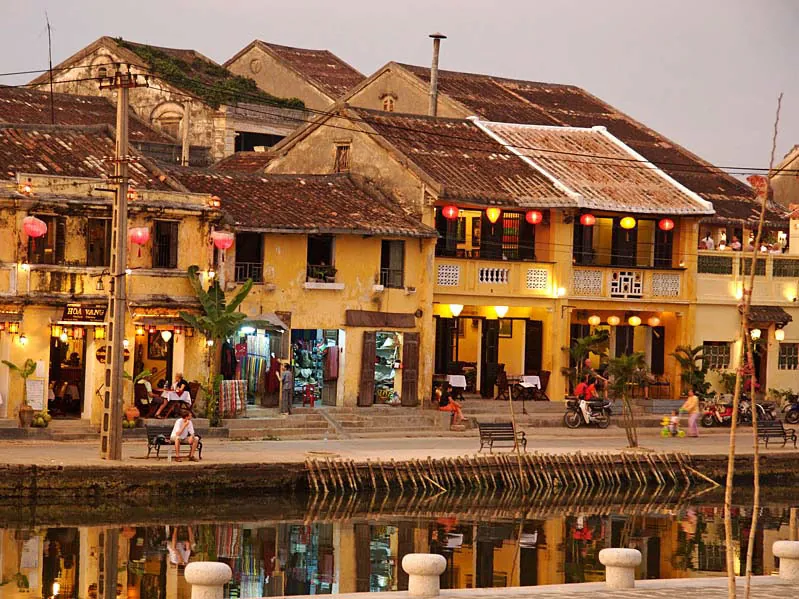
Illustration of Hoi An’s historic town setting; not the featured building or a museum interior. ·
Jean-Marie Hullot · CC BY-SA 3.0 · Resized and converted to WebP

Start with the shared role
The local conservation study identifies Trung Hoa as the common assembly hall of five Chinese community groups in Hoi An. That collective role is a better introduction than a claim that it is the oldest or most important hall. Ask how a shared institution differs from a hall associated with one group. A guide can help distinguish the building’s community identity from any particular person’s ethnicity; avoid using appearance or language to guess who belongs to which community today.
Look at inscriptions as evidence
The conservation study examines horizontal inscribed boards and paired texts. Rather than trying to translate unfamiliar characters from a distant photograph, choose one accessible example and ask for its wording, date and context. Names or dedication information can matter as much as the central large characters. Do not assume every board came from the same workshop or period. Where a transcription or translation is unavailable, recording that uncertainty is more accurate than inventing an uplifting meaning for decorative writing.
Check the actual visitor arrangement
A heritage introduction also records educational associations with the site. It is a historical description, not permission to enter any working classroom or photograph pupils. Confirm the current entrance, public areas, admission and worship arrangements with the site before planning an interior visit. Respect private and educational boundaries if they are present. For an efficient heritage walk, focus on the shared role and one inscription, then connect the experience to the broader trading-town story. Leave time for a guide’s explanation rather than adding another hall simply to increase the count of stops. If reading inscriptions is your main interest, arrange language support before arrival so that a brief visit answers a specific question.
Ask VietnamGuide AI
Ask VietnamGuide AISources
- 1. hoianheritage.net/vi/trao-doi-chuyen-nganh/chuyen-de-nghien-cuu-trao-doi/hoanh-phi-lien-doi-tai-hoi-quan-trung-hoa-o-hoi-an-quang-nam-vo-thi-anh-tuyet-truong-dai-hoc-khoa-hoc-xa-hoi-va-nhan-van-dhqg-hcm-dao-vinh-hop-truong-dai-hoc-sai-gon-1-hoi-quan-trung-hoa-va-cac-hoanh-phi-lien-doi-nguoi-hoa-o-644.html
Source checked:
- 2. www.hoianworldheritage.org.vn/en/news/print/Monument/Trung-Hoa-Assembly-Hall-Ngu-Bang-Assembly-Hall-of-Hoian-9.hwh
Source checked:
Explore more
- Duc An house: reading Hoi An’s history of books and political networks
Understand Duc An house through books, anti-colonial networks and its preserved domestic architecture, without assuming current visitor services.
- Tran family chapel: ancestry and thresholds in Hoi An
Understand the Tran family chapel at 21 Le Loi through ancestral worship, domestic space and the meaning of its threshold, with respectful visitor planning.
- Cam Pho communal house: village life beneath Hoi An’s trading history
Read Cam Pho communal house through its village function, ceremonial architecture and archaeological evidence, with careful visit planning.