Travel guide
Why Hoi An is World Heritage: read the trading port as a whole
Hoi An Ancient Town entered the UNESCO World Heritage List in 1999 under criteria concerning cultural exchange and a traditional settlement. Its significance is not limited to one bridge, one old house or a photogenic yellow wall. UNESCO describes a surviving trading-port town in which buildings, plots, streets and the river setting work together. This explanation helps you interpret what you are looking at; it is not another walking route or a replacement for individual monument guides.
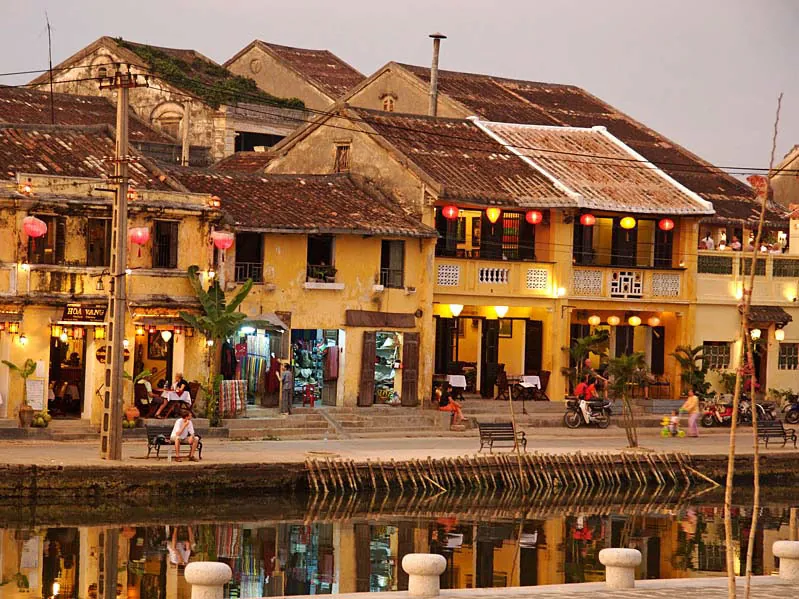
Illustration of Hoi An’s historic town setting; not the featured building or a museum interior. ·
Jean-Marie Hullot · CC BY-SA 3.0 · Resized and converted to WebP

Read the relationship between street and river
The World Heritage account describes streets running along the river and other streets and alleys meeting them at right angles. Trading buildings commonly addressed customers toward the street while connecting goods movement with the water behind. Notice the relationship between a narrow frontage and the depth of a plot, and between neighbouring rooflines, instead of isolating every façade for a photograph. This is a way of understanding the inherited urban structure, not a claim that every present-day building retains an open loading passage or welcomes entry through its rear.
Understand exchange through buildings and use
UNESCO identifies the combination of local and foreign influences, particularly Chinese and Japanese traditions with later European contributions, in the port’s surviving townscape. Timber frames, tiled roofs, houses, assembly and religious spaces form a connected environment, rather than a collection of unrelated national styles. Avoid deciding that a single decorative motif proves the nationality or exact age of an entire building. Read site-specific interpretation for those details. The wider heritage value lies in how settlement and exchange shaped the town over time, as well as in buildings that can be appreciated individually.
Distinguish UNESCO designations and visit with care
The Ancient Town’s World Heritage status and Hoi An’s membership of the UNESCO Creative Cities Network are different recognitions. The latter, in Crafts and Folk Art since 2023, concerns creativity, skills and cultural development; it does not extend the World Heritage property to every workshop or resort using the town’s name. Nor does either designation guarantee unrestricted access. Respect homes, shops and active places of worship, ask before entering non-public spaces and follow current conservation instructions. Do not interpret repaired timber as automatically inauthentic: UNESCO’s account explicitly explains renewal using traditional repair methods. Old administrative labels or legal summaries in a heritage dossier should not be mistaken for current travel regulations.
Ask VietnamGuide AI
Ask VietnamGuide AISources
- 1. whc.unesco.org/en/list/948/
Source checked:
- 2. www.unesco.org/en/creative-cities/hoi
Source checked:
- 3. www.hoianworldheritage.org.vn/en/news/New-notice/hoi-an-joins-the-unesco-creative-cities-network-in-2023-782.hwh
Source checked:
Explore more
- Duc An house: reading Hoi An’s history of books and political networks
Understand Duc An house through books, anti-colonial networks and its preserved domestic architecture, without assuming current visitor services.
- Tran family chapel: ancestry and thresholds in Hoi An
Understand the Tran family chapel at 21 Le Loi through ancestral worship, domestic space and the meaning of its threshold, with respectful visitor planning.
- Cam Pho communal house: village life beneath Hoi An’s trading history
Read Cam Pho communal house through its village function, ceremonial architecture and archaeological evidence, with careful visit planning.