Travel guide
Van Duc Pagoda: Hoi An Buddhism beside the Co Co River
Vạn Đức offers a different way to understand Hoi An from the merchant houses of the Ancient Town. Its story connects a Buddhist teaching lineage with the Cổ Cò River landscape. Go with that specific interest rather than treating the pagoda as an interchangeable temple photograph or an automatic stop on a boat excursion.
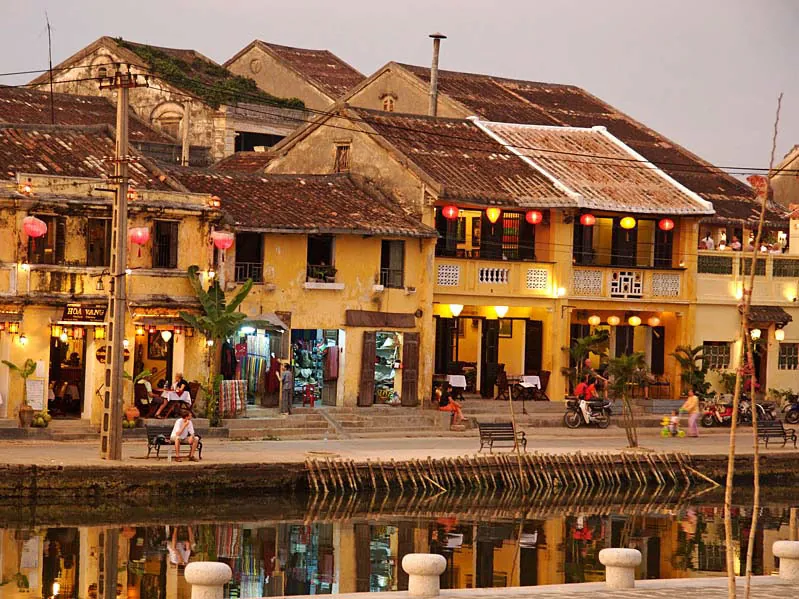
Illustrative context photo: Historic riverside buildings and lanterns in Hoi An's old town, photographed in 2007 ·
Jean-Marie Hullot · CC BY-SA 3.0 · Resized and converted to WebP

Follow the names and teaching lineage
The Hoi An heritage centre identifies Minh Lượng as the pagoda's founding monk and connects Vạn Đức with the Lâm Tế Chúc Thánh tradition. Its historical account also records the names Lang Thọ and Chùa Cây Cau before the name Vạn Đức. These names help distinguish one institution's history from a general list of Hoi An temples. If a guide or an authorised explanation is available, ask how the different names relate to the same site. Do not interpret a shared Buddhist lineage as meaning every pagoda has the same founder or collection.
Read the river setting as history, not a transport promise
The official site description places the pagoda beside the Cổ Cò River and explains the river's historical connection between the Da Nang and Hoi An coastal entrances. That adds a question to your visit: how could movement by water support travel, trade and religious contact? Historical merchant access does not establish a present-day landing, navigable tourist route or scheduled boat service. Choose your actual transport using current information and confirm the precise destination with the driver or organiser. Do not book a river trip on the assumption that a heritage description guarantees arrival at the pagoda.
Keep religious heritage separate from exhibition access
Heritage researchers record objects such as religious texts, statues, bells and printing blocks associated with the site. That is not confirmation that every object is on public view. Ask which spaces may be visited, and accept limits during worship or private activities. Follow on-site directions about clothing, shoes and photography; do not move devotional objects to improve a picture. Before making a special journey, verify current opening and visitor arrangements directly. This guide offers historical interpretation, not an admission package, a meditation course, a guaranteed guide or a claim that rituals produce a particular outcome.
Ask VietnamGuide AI
Ask VietnamGuide AISources
Explore more
- Duc An house: reading Hoi An’s history of books and political networks
Understand Duc An house through books, anti-colonial networks and its preserved domestic architecture, without assuming current visitor services.
- Tran family chapel: ancestry and thresholds in Hoi An
Understand the Tran family chapel at 21 Le Loi through ancestral worship, domestic space and the meaning of its threshold, with respectful visitor planning.
- Cam Pho communal house: village life beneath Hoi An’s trading history
Read Cam Pho communal house through its village function, ceremonial architecture and archaeological evidence, with careful visit planning.